Overdrawn Director's Loan Account and S455 Tax
When you borrow money from your own limited company, that amount is tracked in a director's loan account (DLA). If you owe the company money at the end of your accounting period, the account is described as overdrawn. An overdrawn director's loan account triggers specific tax rules — and if you don't repay it in time, HMRC will charge your company a tax called S455.
Understanding how S455 works, when it applies, and how to avoid it can save your company a significant tax bill.
What does an overdrawn director's loan account mean?
A director's loan account becomes overdrawn when you have taken more money out of the company than you have put in or been paid through salary and dividends. Common causes include:
- Withdrawing cash as informal loans to yourself
- Personal expenses paid by the company on your behalf
- Taking drawings before dividends are formally declared
What is the S455 tax charge?
S455 refers to Section 455 of the Corporation Tax Act 2010. It is a tax charge imposed on close companies (typically small owner-managed limited companies) when a director-shareholder owes money to the company.
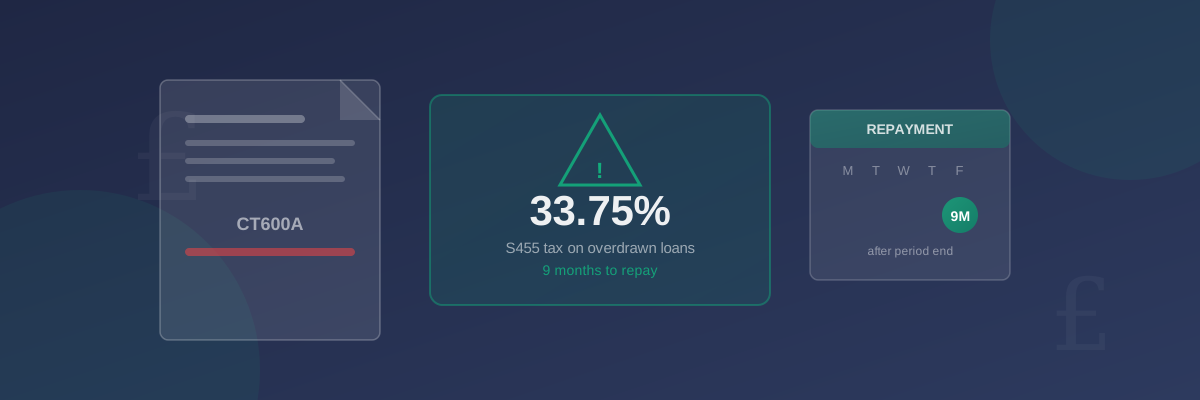
If the loan is still outstanding nine months and one day after the end of the accounting period in which it was made, your company must report the outstanding balance on the CT600A supplement and pay S455 tax at 33.75% of the outstanding loan amount.
For example, if you owe the company £20,000 at the end of your accounting period and have not repaid it within the nine-month window, HMRC will charge £6,750 in S455 tax on your company's corporation tax return.
This is not a write-off — the S455 charge is repayable once the loan is repaid, but you have to wait until nine months after the end of the accounting period in which repayment occurred. For large loans repaid late, this represents a significant temporary cash cost.
The nine-month repayment window
The nine-month-and-one-day rule is the most important deadline to understand:
- Your accounting period ends (for example, 31 March 2026)
- You have until 1 January 2027 (nine months and one day later) to repay the overdrawn balance
- If the loan is cleared by this date, no S455 charge applies
- If any balance remains on that date, S455 is due on the outstanding amount
The £10,000 benefit in kind threshold
If you owe the company more than £10,000 at any point during the tax year, the overdrawn balance is treated as a benefit in kind. This means:
- Your company must report the loan on a P11D form
- The company must pay Class 1A National Insurance on the notional interest benefit
- You may personally owe income tax on the benefit
Bed and breakfasting: the 30-day rule
HMRC is alert to the practice of temporarily repaying a director's loan just before the nine-month deadline and then immediately re-borrowing. This is called "bed and breakfasting" and HMRC has specific rules to counter it.
If you repay a loan and take out a new loan within 30 days of the repayment — and the new loan is for more than £5,000 — the repayment is matched against the new borrowing first. The original outstanding balance continues to be treated as if it were not repaid.
This means a short-term repayment funded by a quick re-loan does not clear the S455 liability. To genuinely clear the debt, the money must come from outside the company (for example, from your salary, dividends, or personal funds).
How to avoid S455 tax
The most straightforward ways to eliminate or avoid an S455 charge are:
- Declare a salary or dividend to clear the outstanding balance before the nine-month deadline. Ensure sufficient retained profits to support a valid dividend.
- Repay the loan from personal funds — transfer money from your personal account back to the company's bank account.
- Write off the loan — the company forgives the debt. This creates a personal income tax liability for you, as the write-off is treated as income, but eliminates the S455 charge. If the loan exceeds £10,000, you will also pay income tax on the benefit.
How S455 is reported on your corporation tax return
S455 is reported on the CT600A supplement, which forms part of your company's CT600 corporation tax return. The supplement captures:
- The total of all loans to participators outstanding at the end of the accounting period
- Any repayments made before the nine-month-and-one-day deadline
- The tax due at 33.75%
Reclaiming S455 once the loan is repaid
Once the overdrawn balance is repaid (or written off, or released), your company can reclaim the S455 tax that was paid. The reclaim is not immediate:
- Relief is due nine months and one day after the end of the accounting period in which the repayment was made
- You must submit a claim to HMRC — it is not automatic
- Claims must be made within four years of the end of the accounting period
This time lag is one of the key reasons S455 is costly — your company effectively lends HMRC money interest-free until the claim is processed.
Common mistakes with director's loan accounts
Undeclared personal expenses: Company credit card bills or expenses paid on your behalf accumulate in the DLA without you noticing. Regular reconciliation prevents surprises at year-end.
Informal drawings treated as salary: Withdrawals that are not formally documented as salary, dividend, or repayment of legitimate expenses go into the DLA by default.
Missing the bed-and-breakfasting rule: Temporarily repaying a loan and immediately re-borrowing does not clear the S455 liability if the new borrowing exceeds £5,000 within 30 days.
Failing to reclaim S455 after repayment: Once the loan is repaid, many directors forget to submit the formal reclaim. The refund is not automatic, and the four-year time limit applies.
Frequently Asked Questions
What is the S455 tax rate on director's loans?
The S455 tax rate is 33.75% of the outstanding loan balance. This applies to loans made on or after 6 April 2022. The rate aligns with the higher rate of dividend tax and applies to all close company director's loans that are not repaid within nine months and one day of the end of the accounting period.
Can I avoid S455 by declaring a dividend?
Yes. Declaring a dividend to cover the overdrawn balance is one of the most common ways to avoid S455 — provided the company has sufficient distributable reserves to support the dividend. The dividend must be properly documented with a board resolution and dividend voucher. An undocumented or illegal dividend (paid when the company has no distributable profits) does not clear the S455 liability.
Is S455 refunded when I repay the loan?
Yes, S455 is a temporary charge. Once you repay the loan (or the company writes it off), you can reclaim the S455 paid. However, the refund is not immediate — it becomes due nine months and one day after the end of the accounting period in which the repayment occurred, and you must submit a formal claim to HMRC.
Does an overdrawn director's loan count as income?
An overdrawn director's loan is not income — it is a loan. However, if the loan is written off by the company, the amount forgiven becomes taxable income in your hands, subject to income tax (and potentially National Insurance). If the loan exceeded £10,000 at any point during the year, the company must also report a benefit in kind for the notional interest.
What happens if I never repay the director's loan?
If the loan remains outstanding beyond the nine-month deadline, S455 is charged at 33.75%. The charge stays on your company's account until the loan is cleared. If the loan is never formally resolved, it can become a significant problem during a company closure — outstanding loans may be treated as a distribution, triggering additional tax charges on both the company and the director.
Summary
An overdrawn director's loan account is common for owner-managed companies, but the S455 charge — at 33.75% of the outstanding balance — is a costly consequence of leaving it unresolved past the nine-month deadline. The most efficient approach is to plan ahead: use a combination of salary, dividends, and genuine repayments to clear the balance before the deadline, keep records of all transactions, and check whether the £10,000 benefit in kind threshold has been triggered at any point during the year.
For more on tax-efficient ways to structure your pay as a director, see how to pay yourself from a limited company and tax-efficient ways to take profit out of your company.