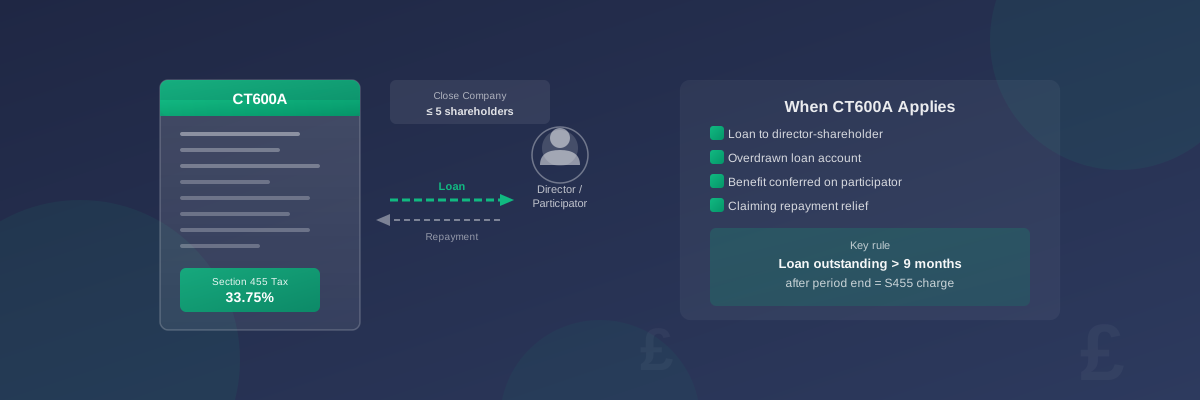
What Is CT600A?
The CT600A is a supplementary page to the main company tax return, used by close companies that have made loans or provided financial benefits to their participators — typically the company's directors or shareholders. If your close company has lent money to a director-shareholder or provided them with a benefit, you will almost certainly need to complete CT600A and attach it to your CT600 company tax return.
This guide explains what CT600A is, when it applies, how Section 455 tax works, and what happens when a loan is repaid.
What Is a Close Company?
A close company is a UK limited company that is owned and controlled by five or fewer shareholders, or by any number of shareholders who are also directors. The vast majority of small owner-managed limited companies in the UK are close companies — if you run a small limited company and you are both a director and a shareholder, your company is almost certainly one.
Being a close company does not carry any particular disadvantage in itself, but it does trigger specific tax rules around certain transactions — particularly loans to participators.
Who Are Participators?
A participator is broadly anyone who has an interest in the company's income or capital. In practice, for most small companies, the participators are the shareholders. A director who is also a shareholder is a participator; a director who owns no shares is not.
The key distinction matters because Section 455 tax applies to loans made to participators specifically — not to arms-length loans to employees who have no ownership interest in the company.
What Is CT600A For?
CT600A is the supplementary page where your company discloses loans and arrangements that confer benefits on participators. You attach it to your main CT600 return when:
- Your close company has made a loan or advance to a participator during the accounting period
- Your close company has conferred a benefit on a participator (for example, writing off a loan or paying a personal expense on their behalf)
- You are reporting a loan repayment in order to claim relief for Section 455 tax previously paid
How Does Section 455 Tax Work?
When a close company makes a loan to a participator and that loan remains outstanding nine months after the end of the accounting period, the company becomes liable to pay a charge under Section 455 of the Corporation Tax Act 2010.
The charge is calculated as a percentage of the loan balance outstanding at the end of the accounting period. The rate that applies depends on when the loan was made:
| Period | Section 455 rate |
|---|---|
| Before 6 April 2016 | 25% |
| 6 April 2016 to 5 April 2022 | 32.5% |
| From 6 April 2022 onwards | 33.75% |
Section 455 is a temporary charge, not a permanent cost. When the loan is repaid, the company can reclaim the tax it has paid.
What Counts as a Loan?
For Section 455 purposes, a loan is broadly defined and includes:
- A straightforward cash advance to a director-shareholder
- An overdrawn director's loan account — where the director has drawn more from the company than their salary and declared dividends justify
- A benefit conferred on a participator, such as the company paying a personal bill on a director's behalf
- Loans made to a company in which a participator has an interest
- Loans made in the ordinary course of business, where the company's trade is money lending
- Small loans of £15,000 or less, provided the borrower works full-time for the company and does not hold a material interest (broadly, no more than 5% of the shares)
When Is CT600A Due?
CT600A is submitted as part of your CT600 company tax return, which is due 12 months after the end of the accounting period. Any Section 455 tax owed is due nine months and one day after the period ends — the same date as your main corporation tax payment.
It is important to calculate your Section 455 position well before this deadline, particularly if you are considering repaying the loan in time to avoid the charge.
Repaying a Director's Loan
One of the most important features of Section 455 is that the charge is refundable once the loan is repaid. The relief is claimable nine months after the end of the accounting period in which the loan was repaid. There is always a waiting period between repayment and reclaim.
If the director repays the loan within nine months of the end of the accounting period in which it was made, no Section 455 charge arises at all. For example, if your company's accounting period ends on 31 March and the director repays their overdrawn loan account in full by 31 December of the same calendar year, no Section 455 tax is due.
This is why many directors take care to clear any overdrawn loan account before the nine-month deadline. Avoiding the charge entirely is simpler than paying it and waiting to reclaim it.
Avoiding Common Mistakes
Overlooking an Overdrawn Director's Loan Account
The most common CT600A error is failing to recognise that an overdrawn director's loan account constitutes a loan to a participator. If a director has drawn more from the company than their salary and declared dividends, the difference is a loan — and if it remains outstanding beyond nine months after the year end, Section 455 tax applies.
Treating Loan Write-Offs Incorrectly
If your company writes off or releases a director's loan, this is treated as a distribution — broadly equivalent to paying a dividend. The director will have income tax to pay on the written-off amount, and the company will not receive a corporation tax deduction for it. This can produce a worse tax outcome than simply repaying the loan.
Missing the Repayment Relief Claim
If a loan has been repaid and Section 455 tax was previously paid, the company can claim a refund through the corporation tax self-assessment process. This reclaim is easy to overlook — particularly when a director repays a loan in a later accounting period. Do not leave it unclaimed.
Related Guides
CT600A works alongside the main company tax return. For a detailed guide to how director's loan accounts arise and how to manage them, see Directors' Loans and CT600. For a broader overview of the company tax return and its supplementary pages, see What Is CT600?.
Summary
CT600A is the supplementary page used by close companies to report loans and financial benefits provided to participators. The key trigger is Section 455 tax, which currently applies at 33.75% on loan balances outstanding nine months after the accounting period end. The charge is temporary — it can be reclaimed once the loan is fully repaid, subject to a nine-month waiting period. Most small owner-managed companies should review their director's loan account position before every year end to avoid unexpected Section 455 liabilities.