Directors Loan Account and CT600: What to Report
Directors often take money from their company or put money in. These "directors loan accounts" have specific tax implications and reporting requirements on your CT600.
What Is a Directors Loan Account?
A directors loan account (DLA) tracks money flowing between the director and the company.
| Direction | What It Means |
|---|---|
| Company owes director | Director has put money in (credit balance) |
| Director owes company | Director has taken money out (debit balance) |
The Two Directions Explained
Director Owes Company (Overdrawn DLA)
You've taken more money out than you've put in or been paid.
Causes:
- Taking cash beyond salary
- Personal expenses paid by company
- Informal "borrowing"
Company Owes Director (Credit DLA)
You've put money into the company or haven't taken out what you're owed.
Causes:
- Loans to help the company
- Unpaid salary or dividends
- Personal expenses you've paid
Section 455 Tax
What Is It?
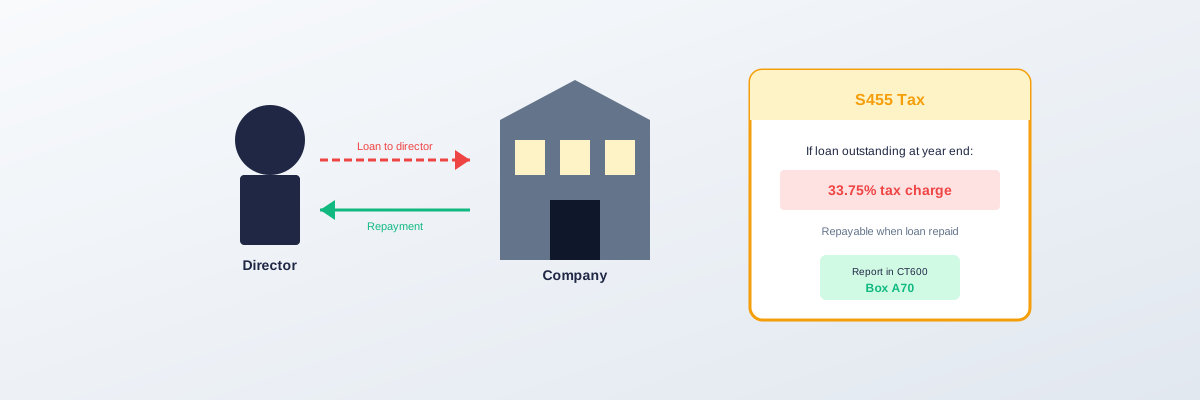
When a company loans money to a participator (usually a director), a 33.75% tax charge applies.
When It Applies
| Situation | S455 Tax? |
|---|---|
| Director owes company at year-end | Yes |
| Director repays within 9 months | No (or refundable) |
| Company owes director | No |
| Small amounts (under £15,000) | Still applies |
The Rate
33.75% of the outstanding loan amount (this mirrors the higher rate of dividend tax).
How to Report on CT600
If S455 Tax Applies
- Complete CT600A (Loans to Participators)
- Report the loan amount
- Calculate the tax (loan × 33.75%)
- Pay the tax with your corporation tax
Where It Appears
| Item | Location |
|---|---|
| Loan amount | CT600A |
| S455 tax | Box 475 (included in total tax) |
| Payment | Due 9 months + 1 day after year-end |
If No S455 Tax Applies
If the loan is repaid or cleared before 9 months + 1 day after year-end:
- No S455 tax to report
- No CT600A required for that loan
- Keep records of repayment
Timeline Example
Year-end: 31 March 2025 Director loan at year-end: £20,000
| Date | Event |
|---|---|
| 31 March 2025 | Year-end, loan = £20,000 |
| 1 January 2026 | CT payment deadline (9m + 1d) |
| If repaid by this date | No S455 tax |
| If NOT repaid | S455 tax = £6,750 (33.75%) |
| 31 March 2026 | CT600 filing deadline |
Getting S455 Tax Back
If you pay S455 tax but later repay the loan:
The Refund Process
- Repay the loan to the company
- Complete form L2P (claim for repayment)
- Submit to HMRC
- Receive refund (9 months after the end of the accounting period in which repayment occurred)
Example
- Paid S455 tax in January 2026: £6,750
- Repaid loan in July 2026
- Claim refund: After April 2027 (9m after March 2027 year-end)
Avoiding S455 Tax
Option 1: Repay Before Deadline
Simply repay the loan within 9 months of year-end. No tax applies.
Option 2: Declare Dividends
If you have sufficient profits:
- Declare dividend to yourself
- Use dividend to clear the loan
- Pay dividend tax (lower than S455)
Option 3: Take Salary
Convert the loan to salary:
- Run through payroll
- Clears the loan
- Employer NI applies
Option 4: Bed and Breakfasting Rules
Don't try this:
- Repay before deadline
- Re-borrow after deadline
- HMRC has anti-avoidance rules
- 30-day rule applies
Benefits in Kind
If the loan exceeds £10,000 and no interest is charged:
| Situation | Tax Consequence |
|---|---|
| Loan over £10,000, no interest | P11D benefit |
| Beneficial interest rate | Taxable benefit |
| Official rate (currently 2.25%) | Benchmark rate |
Common Scenarios
Scenario 1: Informal Drawings
Problem: Director takes £15,000 during the year informally.
Solution options:
- Declare as salary (process through PAYE)
- Declare as dividend (if profits allow)
- Repay from personal funds
- Pay S455 tax and claim back later
Scenario 2: Business Expenses on Personal Card
Situation: Director pays company expenses personally.
Result: Company owes director (no tax issue).
Action: Reimburse director or leave as credit balance.
Scenario 3: Mixed Account
Situation: Some months director owes company, some months company owes director.
What matters: The balance at year-end.
Record Keeping
What to Track
| Record | Purpose |
|---|---|
| All payments to/from director | Calculate balance |
| Year-end balance | Determine S455 |
| Repayment dates | Prove deadline met |
| Interest charged (if any) | P11D reporting |
Reconciliation
Regularly reconcile:
- Bank statements
- Expenses claims
- Salary/dividend records
- Personal payments
Frequently Asked Questions
Is S455 tax in addition to corporation tax?
Yes. It's a separate tax on the loan, not part of the normal CT calculation.
What if the director dies with an outstanding loan?
The debt may be written off. This has different tax consequences (income tax for the estate).
Can family members trigger S455?
Yes. Loans to "participators" include family members connected to the director.
What about loans from the director to the company?
No S455 implications. The company can pay interest on the loan (which is tax-deductible for the company).
Is there a de minimis amount?
No. Even small loans technically trigger S455. Practically, HMRC may not pursue very small amounts, but the law applies.
Summary
| Situation | Action |
|---|---|
| Director owes company at year-end | Consider S455 tax |
| Loan repaid within 9 months | No S455 tax |
| Loan not repaid | Pay 33.75% S455 tax |
| Company owes director | No S455 issue |
| Loan over £10,000, no interest | P11D benefit |
Related guides:
- CT600 Filing Guide
- CT600 Boxes Explained