Capital Allowances Calculator: How to Work Out Your Claim
Capital allowances let your company deduct the cost of qualifying assets — equipment, machinery, vehicles — from its taxable profit, reducing the corporation tax you owe. Understanding how to calculate your claim correctly is essential for an accurate company tax return.
This guide explains the main types of capital allowances, the current limits, how the calculation works, and where the figures appear on the CT600.
What Are Capital Allowances?
When your company buys plant or machinery for business use, you generally cannot deduct the full cost as a trading expense in your profit and loss account (unlike day-to-day running costs such as rent or salaries). Instead, you claim capital allowances through your company tax return to deduct the cost from taxable profit — either all at once or spread over several years.
The main types are:
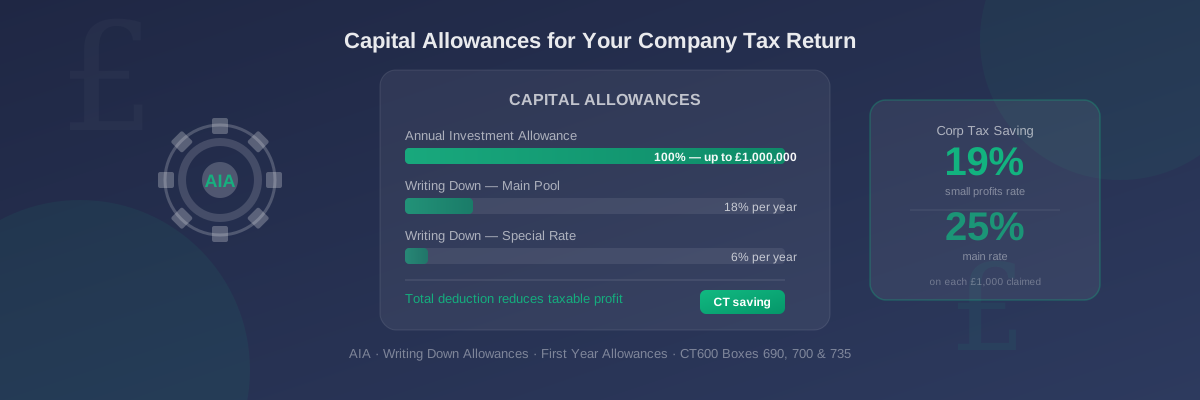
- Annual Investment Allowance (AIA) — 100% deduction in the year of purchase, up to the AIA limit
- Writing Down Allowance (WDA) — a percentage deduction each year for assets not covered by AIA
- First Year Allowances (FYA) — 100% deduction for specific qualifying assets, such as zero-emission vehicles
Annual Investment Allowance (AIA)
The Annual Investment Allowance is the most important capital allowances tool for most small and medium-sized companies. It allows you to deduct 100% of the cost of qualifying plant and machinery in the year you buy it, rather than spreading the deduction over several years.
The current AIA limit is £1,000,000 per year, permanently set at this level since January 2019. This means almost all capital expenditure by small companies can be fully deducted in the year of purchase. Source: GOV.UK — Annual Investment Allowance.
What qualifies for AIA?
Most plant and machinery qualifies, including:
- Office equipment, computers, and servers
- Manufacturing and workshop machinery
- Tools and specialist equipment
- Commercial vehicles — vans, lorries, and similar (not cars)
- Fixtures and fittings in commercial property
What does NOT qualify for AIA?
- Cars — these go into the writing down allowance pools based on CO₂ emissions
- Assets previously owned for personal use before transferring to the company
- Assets received as gifts
Pro-rata for short accounting periods
If your company's accounting period is less than 12 months, the AIA limit is reduced proportionately. For example, a 9-month period has an AIA limit of £750,000 (£1,000,000 × 9/12). This is particularly relevant for companies in their first year of trading.
Writing Down Allowances (WDA)
For assets not covered by AIA — most commonly cars, or expenditure above the AIA limit — you use writing down allowances. Assets are grouped into pools and a fixed percentage is deducted from the pool balance each year.
Main pool (18% per year):
- Most plant and machinery
- Cars with CO₂ emissions of 50g/km or less (from April 2021)
- Cars with CO₂ emissions above 50g/km
- Long-life assets (expected useful life over 25 years)
- Thermal insulation of existing commercial buildings
- Integral features — lifts, heating systems, electrical systems, air conditioning
How to Calculate Your Capital Allowances
Follow these steps for a standard 12-month accounting period:
Step 1: List qualifying expenditure
Identify all plant and machinery purchased during the period. Exclude cars (handled separately) and any non-qualifying assets.
Step 2: Apply AIA
Claim AIA on qualifying expenditure up to £1,000,000. If total qualifying expenditure is below the AIA limit, the entire amount is deductible this period.
Step 3: Pool expenditure above the AIA limit
Any expenditure above the AIA limit is added to the appropriate pool (main pool or special rate pool depending on the asset type).
Step 4: Handle cars separately
Cars are added directly to the appropriate pool based on CO₂ emissions. They cannot claim AIA but do attract WDA each year.
Step 5: Apply writing down allowances
Calculate 18% (main pool) or 6% (special rate pool) of the opening pool balance plus any new additions not covered by AIA.
Step 6: Total your claim
Add AIA + WDA to arrive at your total capital allowances claim for the period.
Worked Example
A company with a 12-month accounting period purchases the following:
| Asset | Cost | AIA eligible? |
|---|---|---|
| Workshop machinery | £55,000 | Yes |
| Commercial van | £28,000 | Yes |
| Company car (100g/km CO₂) | £32,000 | No — main pool WDA |
Main pool: Opening balance £0 + car £32,000 = £32,000. WDA at 18% = £5,760.
Total capital allowances: £83,000 + £5,760 = £88,760
At the 19% small profits rate, this reduces corporation tax by £16,864. At the 25% main rate, the saving is £22,190.
Capital Allowances on the CT600
Capital allowances are reported in the capital allowances supplement of the CT600:
- Box 690 — Annual Investment Allowance claimed in this period
- Box 700 — Total capital allowances (AIA plus WDA and any other allowances)
- Box 735 — Writing down allowances from the main pool
Capital Allowances and Losses
If capital allowances create or increase a trading loss, that loss can be carried forward to offset future profits. You can also choose not to claim the full AIA in a given year — for example, to avoid creating a loss when a small profit would be more useful (keeping profits within the 19% small profits rate band, for instance).
See our corporation tax losses guide for more on how losses work on the company tax return.
First Year Allowances
First Year Allowances (FYAs) provide a 100% deduction in the year of purchase for specific qualifying assets, separately from AIA. The main current FYA is for zero-emission cars and vans — these qualify for 100% FYA without using up any AIA.
The list of FYA-qualifying assets changes over time, so always check GOV.UK capital allowances for what currently qualifies.
Capital Allowances for Property Companies
If your company holds commercial property, certain expenditure on integral features (heating, lighting, lifts, electrical systems) qualifies for capital allowances at the special rate (6% WDA). Structural elements of the building itself do not qualify.
For residential property companies, capital allowances are generally not available on the property itself — though equipment used in the business may still qualify. See our CT600 for property companies guide for more detail on the specific considerations for property businesses.
Summary
Capital allowances are a significant tax relief for companies investing in equipment, vehicles, and machinery. The Annual Investment Allowance (currently £1,000,000 per year) covers most expenditure for small companies, providing a full deduction in the year of purchase.
For a complete picture of what qualifies and how to report your claim, read our capital allowances CT600 guide. To see how capital allowances affect your overall corporation tax liability, use our corporation tax calculator.
AIA limits and WDA rates are set by HMRC. Always verify current figures at GOV.UK before preparing your company tax return.