Corporation Tax Calculator: How to Work Out What You Owe
Every UK limited company that makes a profit needs to work out how much corporation tax it owes. The calculation depends on your company's taxable profits, the applicable tax rate, and whether you qualify for marginal relief.
This guide explains how corporation tax is calculated, walks through worked examples at each rate, and covers the factors that affect your bill — including associated companies and short accounting periods.
The Corporation Tax Rates
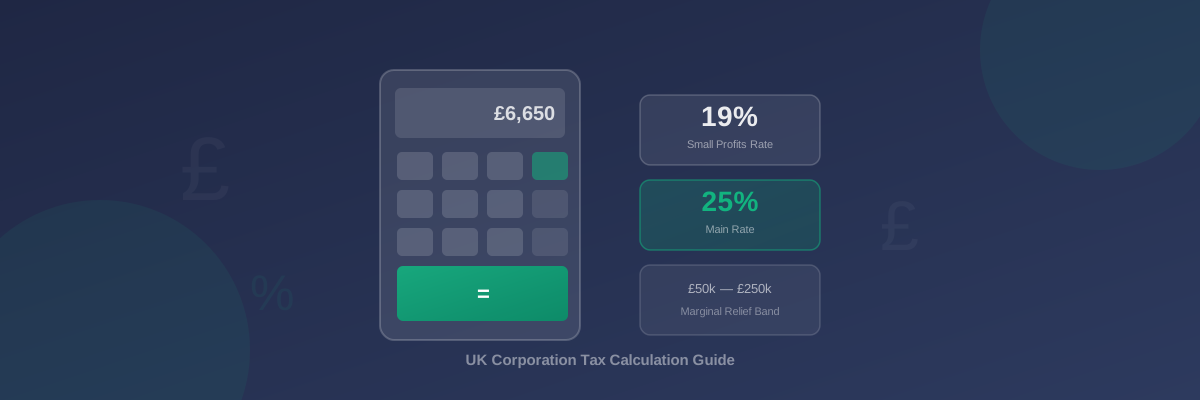
From 1 April 2023, two rates of corporation tax apply in the UK:
| Taxable Profits | Rate |
|---|---|
| £50,000 or less | 19% (small profits rate) |
| £250,001 and above | 25% (main rate) |
| £50,001 to £250,000 | Tapered — marginal relief applies |
These thresholds are reduced proportionately for short accounting periods and divided by the number of associated companies. Both adjustments are explained below.
Simple Corporation Tax Calculations
If your profits fall clearly within one rate band, the calculation is straightforward.
Example 1 — Small profits rate
- Taxable profits: £35,000
- Rate: 19%
- Corporation tax: £35,000 × 19% = £6,650
- Taxable profits: £400,000
- Rate: 25%
- Corporation tax: £400,000 × 25% = £100,000
Marginal Relief Calculation
For profits between £50,000 and £250,000, marginal relief reduces your effective tax rate. You pay the main rate of 25% on all profits, then deduct the marginal relief amount.
The marginal relief fraction is 3/200 (set in UK legislation).
Formula:
``` Marginal Relief = (£250,000 − Taxable Profits) × 3/200 ```
Example 3 — Marginal relief
- Taxable profits: £150,000
- Tax at 25%: £37,500
- Marginal relief: (£250,000 − £150,000) × 3/200 = £100,000 × 0.015 = £1,500
- Corporation tax payable: £37,500 − £1,500 = £36,000
- Effective rate: approximately 24%
- Taxable profits: £60,000
- Tax at 25%: £15,000
- Marginal relief: (£250,000 − £60,000) × 3/200 = £190,000 × 0.015 = £2,850
- Corporation tax payable: £15,000 − £2,850 = £12,150
- Effective rate: approximately 20.25%
For a detailed explanation of how marginal relief works and is reported on the form, see our guide to marginal relief and corporation tax.
What Counts as Taxable Profit?
Your taxable profit is not simply your accounting profit. Before applying the tax rate, you adjust for:
- Allowable expenses — costs incurred wholly and exclusively for business purposes
- Capital allowances — deductions for qualifying capital expenditure (plant, machinery, equipment)
- Losses brought forward — losses from previous years can reduce current year taxable profit
- Disallowable expenditure — costs that are not deductible for tax (client entertaining, depreciation, fines)
- Directors' loan adjustments — certain overdrawn director loan balances give rise to an additional tax charge (S455 tax)
For an overview of which figures go where on the form, see our CT600 boxes explained guide.
Associated Companies: Adjusted Thresholds
If your company has associated companies — broadly, companies under common control — the £50,000 and £250,000 thresholds are divided by the total number of companies in the associated group (including your company).
How the divisor works:
- Box 326 on the CT600 asks for the number of associated companies (not counting your own)
- The thresholds are divided by: number of associated companies + 1 (to include your company)
- Associated companies entered in Box 326: 1
- Divisor: 1 + 1 = 2
- Adjusted small profits threshold: £50,000 ÷ 2 = £25,000
- Adjusted main rate threshold: £250,000 ÷ 2 = £125,000
For a full explanation of the rules around associated companies, see our guide to associated companies and corporation tax.
Short Accounting Periods
If your accounting period is shorter than 12 months — which happens in your first year, or if you change your year-end — the thresholds are reduced proportionately.
Formula:
``` Adjusted threshold = Annual threshold × (Days in period ÷ 365) ```
Example — Nine-month period
- Accounting period: 9 months (275 days)
- Adjusted small profits threshold: £50,000 × 275/365 = £37,671
- Adjusted main rate threshold: £250,000 × 275/365 = £188,356
Key CT600 Boxes for Tax Calculation
Once the tax is calculated, it appears in several boxes on the CT600:
| Box | Description |
|---|---|
| Box 410 | Total profits chargeable to corporation tax |
| Box 430 | Corporation tax at the main rate (25%) |
| Box 435 | Corporation tax at the small profits rate (19%) |
| Box 450 | Marginal relief deduction |
| Box 470 | Corporation tax chargeable (after marginal relief) |
Filing and Paying Your Corporation Tax
Once you know your tax liability:
- Complete the CT600, entering your taxable profits and claiming any available reliefs
- Attach iXBRL-tagged accounts (required by HMRC for all company returns)
- Submit online using HMRC-approved software before the 12-month filing deadline
- Pay corporation tax due by the payment deadline — nine months and one day after your accounting period ends
For a step-by-step guide to the full process, see how to file your company tax return.
Common Calculation Mistakes
Using accounting profit instead of taxable profit. Accounting profit includes depreciation and other non-deductible items. Always make the required tax adjustments before applying the rate.
Forgetting disallowable expenditure. Client entertainment, depreciation, and penalties must be added back to your accounting profit before calculating tax.
Not claiming capital allowances. The Annual Investment Allowance (AIA) lets you deduct the full cost of qualifying plant and machinery in the year of purchase. Missing it can significantly overstate your taxable profit.
Overlooking the associated companies rules. If you or a connected person controls another company, the reduced thresholds may apply — this can push you into a higher effective rate unexpectedly.
Ignoring losses from prior years. If your company made a loss in a previous period, this can be carried forward to reduce the current year's taxable profit.
Summary
Calculating corporation tax for a UK limited company means applying the correct rate — 19% or 25% — to your taxable profit, with a tapered marginal relief for profits between £50,000 and £250,000. Both thresholds reduce proportionately for short accounting periods and are divided by the number of associated companies.
Tax software handles these calculations automatically: you enter your profit figures and the software determines the correct rate, calculates marginal relief where applicable, and populates the CT600. For current rates and thresholds, always refer to the GOV.UK corporation tax rates page.