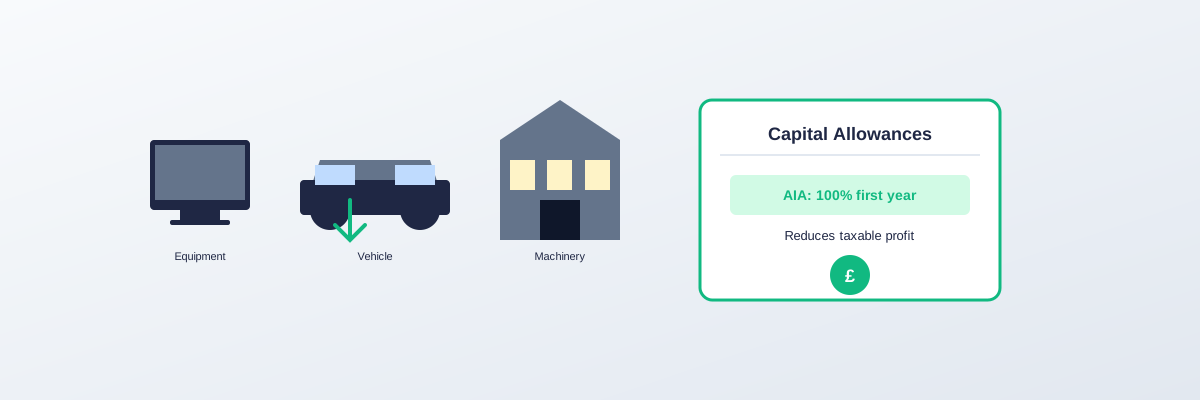
Capital Allowances on CT600: Complete Guide
Capital allowances let you deduct the cost of business assets from your profits, reducing your corporation tax. This guide explains how they work and how to claim them on your CT600.
What Are Capital Allowances?
When your company buys assets (equipment, vehicles, machinery), you can't deduct the full cost as an expense in your accounts. Instead, you claim capital allowances on your CT600.
Key concept: Depreciation in your accounts ≠ tax deductible. Capital allowances replace depreciation for tax purposes.
Example
| Your Accounts | Your CT600 |
|---|---|
| Computer cost: £2,000 | Computer cost: £2,000 |
| Depreciation: £400/year | Capital allowance: £2,000 (year 1) |
| Deducted over 5 years | Deducted in full immediately |
Types of Capital Allowances
Annual Investment Allowance (AIA)
The most important one for small companies.
| Aspect | Detail |
|---|---|
| Rate | 100% |
| Limit | £1,000,000 per year |
| What qualifies | Plant and machinery |
| When to claim | Year of purchase |
Writing Down Allowance (WDA)
For amounts exceeding AIA or items not qualifying:
| Pool Type | Rate |
|---|---|
| Main rate pool | 18% per year |
| Special rate pool | 6% per year |
First Year Allowances
Some assets get 100% relief regardless of AIA:
- Electric cars (100% FYA)
- Zero-emission goods vehicles
- Certain energy-efficient equipment
- Water-saving technologies
What Qualifies for Capital Allowances?
Qualifying Items
- Computers and IT equipment
- Office furniture
- Machinery and tools
- Commercial vehicles (vans, lorries)
- Cars (with restrictions)
- Plant for manufacturing
- Solar panels
- Air conditioning (as integral feature)
Non-Qualifying Items
- Land
- Buildings (separate rules)
- Stock/inventory
- Leased assets (lessor claims)
- Items for resale
- Personal items
How to Claim on Your CT600
The Process
- Identify qualifying purchases in the accounting period
- Calculate the allowance (usually 100% via AIA)
- Add back depreciation in your tax computation
- Deduct capital allowances separately
- Enter in Box 165 (or relevant box) of CT600
Which Box?
| Allowance Type | CT600 Box |
|---|---|
| Against trading profits | Box 165 |
| Against property income | Box 175 |
| Special situations | Supplementary pages |
Example Calculation
Company buys:
- Computer: £1,500
- Desk: £500
- Car (120g/km CO2): £20,000
| Asset | Allowance Type | Rate | Claim |
|---|---|---|---|
| Computer | AIA | 100% | £1,500 |
| Desk | AIA | 100% | £500 |
| Car | Main pool WDA | 18% | £3,600 |
| Total | £5,600 |
Cars - Special Rules
Electric and Low Emission Cars
| CO2 Emissions | Allowance |
|---|---|
| 0g/km (electric) | 100% First Year Allowance |
| 1-50g/km | 18% Main pool |
| Over 50g/km | 6% Special rate pool |
Private Use Restriction
If a car is used privately (e.g., director's car):
- Calculate the normal allowance
- Restrict by private use percentage
- Claim the business portion only
- Full allowance: £3,600
- Restricted: £3,600 × 75% = £2,700
Calculating Pools
When Pools Matter
If you don't use all your AIA, or have cars, you'll need to track pools.
Main Rate Pool Example
| Year | Pool Value | WDA (18%) | Pool C/F |
|---|---|---|---|
| 1 | £10,000 | £1,800 | £8,200 |
| 2 | £8,200 | £1,476 | £6,724 |
| 3 | £6,724 | £1,210 | £5,514 |
Disposals
When you sell an asset:
- Deduct sale proceeds from the pool
- If pool goes negative = balancing charge (taxable)
- If pool stays positive = continue claiming WDA
Common Mistakes
Mistake 1: Forgetting to Claim
Many companies don't claim capital allowances they're entitled to. Review every fixed asset purchase.
Mistake 2: Wrong Pool
Putting a special rate item in the main pool (or vice versa) causes incorrect calculations.
Mistake 3: Not Adding Back Depreciation
Capital allowances replace depreciation. You must add back depreciation in your computation before deducting allowances.
Mistake 4: Claiming on Leased Assets
If you lease equipment, you usually can't claim capital allowances—the lessor claims instead.
Mistake 5: Cars in AIA
Cars never qualify for AIA. They always go to pools at the appropriate rate.
Practical Examples
Example 1: IT Contractor
Purchases:
- MacBook Pro: £2,500
- Monitor: £500
- Office chair: £300
- AIA: £3,300 (100% in year 1)
- Tax saved (19%): £627
Example 2: Trading Company
Purchases:
- Van: £25,000
- Machinery: £50,000
- Tools: £5,000
- Van: AIA £25,000
- Machinery: AIA £50,000
- Tools: AIA £5,000
- Total: £80,000
- Tax saved (19%): £15,200
Example 3: With Electric Car
Purchases:
- Electric car: £40,000
- Computer: £1,500
- Electric car: 100% FYA = £40,000
- Computer: AIA = £1,500
- Total: £41,500
- Tax saved (19%): £7,885
Frequently Asked Questions
When do I claim - purchase or payment date?
Generally, when the asset becomes available for use, which is usually the purchase date (not order date or payment date).
Can I claim for items bought before incorporation?
Yes, but only if brought into the company and used for the business within the first accounting period.
What if I exceed the AIA limit?
The excess goes into the appropriate pool and gets WDA at 18% or 6% depending on the asset type.
Do I have to claim capital allowances?
No, it's optional. But not claiming means paying more tax than necessary. You can disclaim allowances to preserve losses, but this is rare for small companies.
Can I claim on equipment I already owned?
Only if you transfer ownership to the company at market value when incorporating.
Summary
| Allowance | Rate | Common Items |
|---|---|---|
| AIA | 100% (up to £1m) | Equipment, machinery, vans |
| First Year | 100% | Electric cars, green tech |
| Main Pool WDA | 18% | General items after AIA |
| Special Rate WDA | 6% | High-CO2 cars, integral features |
Related guides:
- CT600 Filing Guide
- CT600 Boxes Explained