CT600 Box 735: Main Pool Allowances Explained
For companies with plant and machinery that is not fully covered by the Annual Investment Allowance, the main pool writing down allowance is the primary mechanism for claiming ongoing tax relief year after year. Box 735 on the CT600 company tax return records the main pool allowances claimed in that accounting period.
This guide explains what the main pool is, which assets belong in it, how to calculate the writing down allowance (WDA), and what the upcoming rate change from April 2026 means for your corporation tax planning.
What Is the Main Pool?
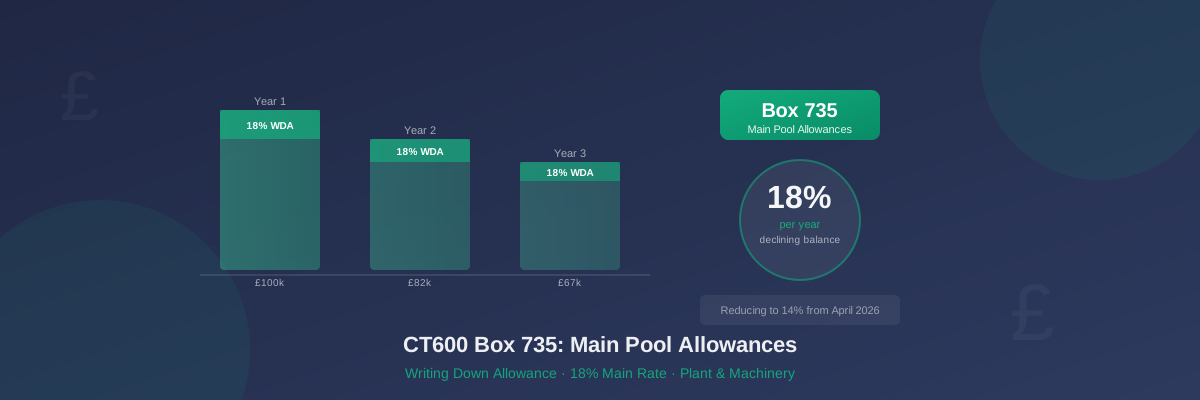
The main pool is the standard capital allowances pool for most types of plant and machinery. Assets in the main pool attract a writing down allowance (WDA) of 18% per year on the declining pool balance.
Unlike the Annual Investment Allowance, which gives 100% relief in the year of purchase, the main pool WDA spreads the tax deduction over many years. Each year you claim 18% of the remaining balance, and the reduced balance carries forward. The pool never fully reaches zero through WDA alone — it keeps declining, year on year, which is why this approach is called the declining balance method.
Most companies will have a main pool balance arising from assets bought in prior years, even if current-year purchases are fully covered by AIA. The pool represents the tax value of those earlier assets that has not yet been deducted.
Which Assets Go into the Main Pool?
The main pool contains most general plant and machinery that does not qualify for a different pool category. Typical main pool assets include:
- Office equipment: computers, servers, printers, telecommunications equipment, photocopiers
- Business vehicles: vans, lorries, and most commercial vehicles; cars with CO₂ emissions of 50g/km or less for new purchases
- Machinery and tools: manufacturing equipment, workshop tools, specialist instruments
- General fixtures: racking, shelving, storage systems
- IT infrastructure: on-premise hardware, network equipment, servers
Assets That Do Not Go into the Main Pool
Some assets are directed to other categories:
| Asset Type | Where It Goes | Rate |
|---|---|---|
| Integral building features (lifts, HVAC, heating) | Special rate pool | 6% WDA |
| Long-life assets (over 25-year life, over £100k cost) | Special rate pool | 6% WDA |
| Solar panels, thermal insulation | Special rate pool | 6% WDA |
| Cars with CO₂ over 50g/km | Special rate pool | 6% WDA |
| Zero-emission cars and vans | 100% first-year allowance | 100% in year 1 |
| Cars with private use | Single asset pool | 18% WDA |
| Short-life assets (by election) | Single asset pool | 18% WDA |
How to Calculate the Main Pool WDA (Box 735)
The writing down allowance from the main pool is calculated each accounting period using this sequence:
- Opening main pool balance — balance brought forward from the last period
- Add qualifying additions — cost of assets entering the main pool this year
- Less AIA claimed on additions — AIA removes assets from the pool; the pool balance is reduced by the AIA amount (because the cost has already been fully deducted via AIA)
- Less disposal proceeds — proceeds from selling or scrapping main pool assets
- Apply the 18% WDA rate — this gives you the writing down allowance for the period
- Closing balance — the remaining balance carried forward to the next period
Worked Example
A company's main pool has an opening balance of £80,000. During the year it buys a new van for £25,000 (AIA claimed) and a forklift for £15,000 (no AIA — limit already used). An old machine is sold for £5,000.
| Step | Amount |
|---|---|
| Opening pool balance b/f | £80,000 |
| + Van purchase | £25,000 |
| + Forklift purchase | £15,000 |
| − AIA on van (Box 690) | (£25,000) |
| − Disposal proceeds | (£5,000) |
| = Net pool before WDA | £90,000 |
| × 18% WDA | £16,200 |
| Closing pool balance c/f | £73,800 |
In subsequent years, the 18% rate applies to the new opening balance of £73,800, producing a WDA of approximately £13,284 — and so on, declining each year.
Short Accounting Periods
If your accounting period is less than 12 months — for example, a newly incorporated company filing its first return — the WDA rate is reduced proportionally:
WDA = pool value × 18% × (months in period ÷ 12)
For a 9-month accounting period: 18% × 9/12 = 13.5%
This applies to both the main pool and the special rate pool.
Small Pools Allowance
If the main pool balance falls to £1,000 or less at any point in the calculation, you may claim the entire remaining balance as a small pools allowance instead of applying the 18% rate.
For example: a main pool balance of £800 could be fully written off in a single year rather than claiming £144 (18% × £800) and carrying forward £656.
The small pools allowance is available separately for the main pool and the special rate pool. You cannot combine the two pools to reach the £1,000 threshold. This allowance is entirely optional — you do not have to claim it if you prefer to preserve the pool for future years.
Balancing Allowances and Charges
Balancing allowance: When your company permanently ceases trading and there is still a balance in the main pool, you claim the full remaining balance as a balancing allowance in the final accounting period. This brings the pool to zero and provides a one-off deduction for the remaining unrelieved expenditure.
Balancing charge: If you sell pooled assets and the total disposal proceeds exceed the pool balance, a balancing charge arises. This is added back to your taxable profits — effectively a clawback of allowances previously claimed. Balancing charges are most likely when assets have been written down significantly over many years and are then sold for more than their pool value.
Budget 2025: Main Pool WDA Reducing from April 2026
A significant change was announced at the Autumn Budget 2025. The main pool writing down allowance rate will reduce:
- From 18% to 14% effective 1 April 2026 (corporation tax)
- From 18% to 14% effective 6 April 2026 (income tax)
Planning consideration: If you have capital expenditure planned that cannot be covered by AIA (for example, car purchases, or spending above the £1m AIA limit), reviewing the timing before April 2026 may be worthwhile. Assets added to the pool before that date will generate 18% WDA for the periods they were purchased.
Source: GOV.UK Capital Allowances
Main Pool vs Annual Investment Allowance
The AIA (Box 690) and the main pool WDA (Box 735) work alongside each other:
- AIA gives 100% relief in the year of purchase — the full cost is deducted in a single period. Assets claimed via AIA leave no pool balance.
- Main pool WDA gives 18% per year on the declining balance — the deduction spreads over many years.
- Any uncovered balance (expenditure above the AIA limit)
- Cars (which cannot use AIA at all)
- Prior years' pool balances not yet fully written down
Relationship Between Box 735 and Box 700
On the CT600:
- Box 700 captures the capital allowances pool position — recording the opening balance, additions, disposals, and closing balance
- Box 735 captures the actual writing down allowance claimed from the main pool in that period
For a company paying the main rate of corporation tax at 25%, a £10,000 main pool WDA saves £2,500 in tax. For companies paying the small profits rate of 19%, the saving is £1,900.
For more on how pool accounting works, see our guide to CT600 Box 700: Capital Allowances Pool.
Corporation Tax Impact: A Longer Example
Consider a company that bought a van three years ago for £30,000, claimed no AIA on it (was a car-type vehicle), and has been taking main pool WDA since:
| Year | Opening Balance | WDA (18%) | Closing Balance | Tax Saved (25%) |
|---|---|---|---|---|
| 1 | £30,000 | £5,400 | £24,600 | £1,350 |
| 2 | £24,600 | £4,428 | £20,172 | £1,107 |
| 3 | £20,172 | £3,631 | £16,541 | £908 |
| 4 | £16,541 | £2,977 | £13,564 | £744 |
Summary
Box 735 on the CT600 records the writing down allowance claimed from the main pool of capital assets — currently 18% per year on the declining balance, reducing to 14% from April 2026. Most general plant and machinery, commercial vehicles, and IT equipment belongs in the main pool. Assets fully covered by AIA leave no pool balance, but prior years' assets and items that cannot use AIA continue to attract WDA each year. Understanding the main pool helps you plan capital expenditure timing and maximise corporation tax relief on your company's assets.