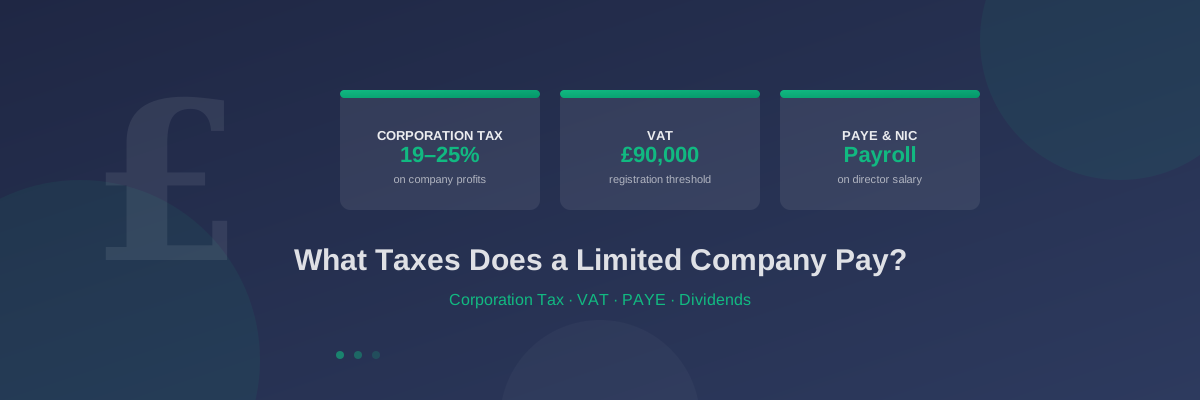
What Taxes Does a Limited Company Pay?
Running a limited company in the UK means dealing with several different taxes, each with its own rates, registration rules, and deadlines. Unlike a sole trader, your limited company is a separate legal entity — so the company itself pays tax on its profits, and you pay personal tax on what you take out.
A limited company typically pays corporation tax on its profits, VAT on its sales if turnover exceeds the registration threshold, and PAYE plus National Insurance on any salaries. Directors pay personal tax on dividends and salary separately through Self Assessment.
Key takeaways
- Corporation tax is the main company tax: 19% on profits up to £50,000, rising to 25% on profits above £250,000, with marginal relief in between
- VAT registration is required once taxable turnover exceeds £90,000 in any rolling 12-month period
- PAYE and National Insurance apply to any salaries the company pays — including a director's salary
- Dividends are taxed personally by shareholders, not by the company itself
- Corporation tax is due 9 months and 1 day after the accounting period ends — before the CT600 filing deadline
What is corporation tax — and how much does a limited company pay?
Corporation tax is the tax a limited company pays on its taxable profits. Every UK limited company must notify HMRC within three months of starting to trade and register for corporation tax.
Current rates (from 1 April 2023):
| Annual profit | Rate |
|---|---|
| Up to £50,000 | 19% (small profits rate) |
| £50,001 to £250,000 | Marginal relief (effective rate between 19% and 25%) |
| Over £250,000 | 25% (main rate) |
For a detailed explanation of how the middle band works, see our guide to marginal relief and how it is calculated.
When do you pay corporation tax?
Corporation tax is due 9 months and 1 day after the end of your accounting period. The company tax return (CT600 form) must be filed with HMRC within 12 months of the accounting period end. Note that the payment deadline comes before the filing deadline — a common source of confusion for new directors.
See our company tax return deadlines guide for worked examples by year-end month.
Does a limited company pay VAT?
VAT (Value Added Tax) is charged on most goods and services. Your limited company must register for VAT if its taxable turnover exceeds £90,000 in any rolling 12-month period — the current threshold as confirmed by GOV.UK.
Voluntary registration is available below this threshold — useful if you sell primarily to VAT-registered businesses and want to reclaim VAT on your own purchases.
Once registered, you charge VAT on your sales and submit a VAT return to HMRC, usually quarterly. Common VAT schemes for smaller companies include:
- Standard rate accounting — track VAT on each invoice issued and received
- Cash accounting — account for VAT when money actually changes hands rather than when invoiced
- Flat Rate Scheme — pay a fixed percentage of gross turnover (rate varies by sector), which reduces bookkeeping
- Annual Accounting Scheme — submit one annual VAT return, with advance payments spread through the year
Does a limited company pay PAYE and National Insurance?
If your limited company pays salaries — including a director's salary — it must register as an employer with HMRC and operate PAYE (Pay As You Earn). The company collects income tax and employee National Insurance from each salary payment and passes them to HMRC, normally by the 22nd of the following month.
The company also pays employer's National Insurance contributions (NIC) on salaries above the secondary threshold. Check GOV.UK for the current secondary threshold and employer NIC rate, which are reviewed each tax year.
Employment Allowance can reduce the employer NIC bill by up to £10,500 per year (2024/25). However, it is not available if the company has only one director who is also the sole employee — a common situation for owner-managed companies.
Many directors take a modest salary — up to or around the NIC threshold to preserve their State Pension record — and top up their income with dividends. This approach reduces the overall National Insurance burden. Our guide on how to pay yourself as a director of a limited company covers the optimal salary and dividend split in detail.
PAYE key dates:
- Payroll submissions must be made to HMRC on or before the date of each payment (Real Time Information)
- PAYE and NIC payments are due by the 22nd of each month following payroll (19th if paying by cheque)
- The payroll year ends on 5 April; P60s must be issued to employees by 31 May
Do directors pay personal tax separately?
Yes. Directors who receive a salary are taxed through PAYE in the normal way. But most directors also receive dividends, which are taxed personally through Self Assessment.
Dividend income is not subject to National Insurance, and dividend tax rates are lower than the equivalent income tax rates — making dividends a popular way to extract profit from a company. However, dividends can only be paid from profits after corporation tax, and a dividend voucher must be prepared each time a dividend is declared.
Most directors must file a Self Assessment tax return each year by 31 January. Our directors' Self Assessment checklist covers what you need to include.
What other taxes might a limited company pay?
Depending on your business activities, a limited company may also encounter:
| Tax | When it applies |
|---|---|
| Business rates | If the company occupies commercial or office premises |
| Stamp Duty Land Tax (SDLT) | When the company purchases property or land in England or Northern Ireland |
| Capital gains (within corporation tax) | When the company sells assets at a profit — this is taxed as part of the corporation tax return, not separately |
| Construction Industry Scheme (CIS) | Contractors and sub-contractors in the construction sector |
How to plan ahead and avoid surprises
The most important habit is setting aside corporation tax throughout the year rather than facing a large unexpected bill when the payment deadline arrives. A common approach is to transfer 20–25% of monthly profits into a dedicated savings pot as you go.
For a full calendar of all the deadlines your limited company faces — corporation tax, VAT, PAYE, Self Assessment, and Companies House — see our UK small business tax calendar and our limited company key tax dates for 2026/27.
Frequently Asked Questions
What taxes does a limited company have to pay?
A UK limited company must pay corporation tax on its profits (19% for profits up to £50,000, 25% for profits above £250,000), VAT if taxable turnover exceeds £90,000, and PAYE plus National Insurance on any salaries it pays. Directors also pay personal tax on dividends and salary through Self Assessment. Business rates apply if the company occupies commercial premises.
When does a limited company pay corporation tax?
Corporation tax is due 9 months and 1 day after the end of the accounting period. For a company with a 31 December year-end, that means the payment is due on 1 October the following year. The company tax return (CT600) is not due until 12 months after the period end — so the payment deadline falls earlier than the filing deadline.
Does a limited company always have to register for VAT?
No. VAT registration is only mandatory when taxable turnover exceeds £90,000 in any rolling 12-month window. Below this threshold, registration is voluntary. Dormant companies and newly incorporated companies with no turnover do not need to register.
Is corporation tax the same as income tax?
No. Corporation tax is paid by the limited company on its taxable profits. Income tax is paid by individuals — including directors — on their salary, dividends, and other personal income. They are two entirely separate taxes assessed independently. A director-shareholder is typically subject to both: the company pays corporation tax, and the director pays income tax through PAYE and Self Assessment.
How much tax does a small limited company actually pay?
A company with £50,000 of taxable profit pays corporation tax at 19%, resulting in a bill of £9,500. If the remaining profit is distributed as dividends to a director-shareholder, the individual then pays dividend tax on those amounts through Self Assessment. The combined effective rate depends on profit levels and how income is extracted. Use our corporation tax calculator to model your own position.
Summary
A UK limited company pays corporation tax on its profits at 19% or 25%, VAT on sales above the £90,000 threshold, and PAYE plus National Insurance on any salaries it pays. Directors pay personal tax on salary and dividends through Self Assessment. Understanding each tax, its rate, and its payment deadline makes cashflow planning straightforward. Keep our limited company key tax dates to hand throughout the year to stay on top of every obligation.