What Is Making Tax Digital for Income Tax?
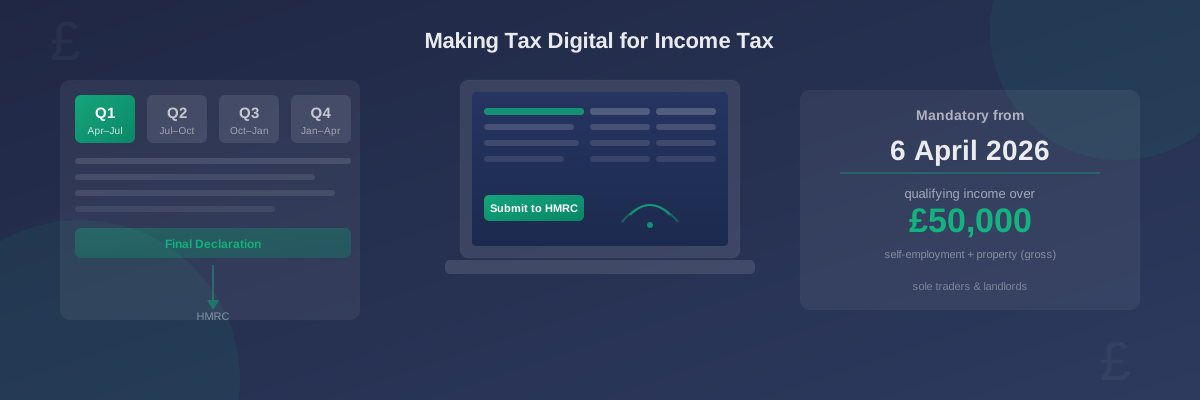
Making Tax Digital for Income Tax (often called MTD ITSA or MTD for Income Tax Self Assessment) is HMRC's programme to move sole traders and landlords away from annual manual Self Assessment returns and onto quarterly digital reporting using compatible software. From 6 April 2026, it becomes mandatory for those with qualifying income above a set threshold — representing the biggest change to personal tax reporting in a generation.
Making Tax Digital for Income Tax requires sole traders and landlords with qualifying gross annual income from self-employment and property above £50,000 to use HMRC-compatible software to keep digital records and submit quarterly updates, in place of a single annual Self Assessment return, from 6 April 2026.
Key takeaways
- Mandatory for sole traders and landlords with qualifying income over £50,000 from 6 April 2026
- Requires HMRC-compatible software — spreadsheets alone do not meet the requirement
- Four quarterly updates per year, plus an annual end-of-period statement and final declaration
- HMRC will not apply penalty points for late quarterly updates in the first tax year (2026/27)
- Limited companies are not affected — MTD for Income Tax is a Self Assessment obligation only
- The threshold is based on gross income (before expenses), not profit
What Is MTD for Income Tax?
Making Tax Digital for Income Tax changes the way sole traders and landlords report their income to HMRC. Instead of completing one annual Self Assessment tax return, affected individuals must:
- Keep digital records of income and expenses using HMRC-compatible software
- Send four quarterly updates to HMRC each tax year
- Complete an end-of-period statement at the end of each accounting period
- Submit a final declaration (replacing the current SA100 annual return) to confirm the full tax position for the year
Who Does MTD for Income Tax Apply To?
MTD for Income Tax applies to sole traders and landlords who are registered for Self Assessment. The qualifying conditions are:
- You are registered for Self Assessment
- You have submitted a tax return in the last two years
- Your total qualifying income from self-employment and property exceeds the relevant threshold
Important: MTD for Income Tax is a Self Assessment obligation. It does not apply to limited companies, which continue to pay corporation tax via a CT600 company tax return. If you run a limited company alongside self-employment activity, your company's filing obligations are entirely separate.
What Counts as Qualifying Income?
The threshold is based on your total gross income — before any expenses — from:
- Self-employment income — turnover from your sole trader business or businesses
- Property income — rental income from UK or overseas residential or commercial property
Example: A freelance consultant with £35,000 in self-employment income and £20,000 in rental income has £55,000 of qualifying income and would be required to use MTD for Income Tax from April 2026. Even though their profit after expenses might be much lower, the threshold is based on gross receipts.
How Does Quarterly Reporting Work in Practice?
Under MTD for Income Tax, the tax year is divided into four reporting quarters. For a standard 5 April year end, the quarters and submission deadlines are:
| Quarter | Period | Submission deadline |
|---|---|---|
| Q1 | 6 April – 5 July | 7 August |
| Q2 | 6 July – 5 October | 7 November |
| Q3 | 6 October – 5 January | 7 February |
| Q4 | 6 January – 5 April | 7 May |
Think of it as replacing one annual return with four lighter quarterly updates plus a shorter annual sign-off — rather than requiring four times as much administration.
What Software Do I Need?
MTD for Income Tax requires software that is recognised by HMRC and able to:
- Create and store digital records of income and expenses
- Submit quarterly updates directly to HMRC's systems
- Produce end-of-period statements and final declarations
HMRC maintains an up-to-date list of recognised software products on GOV.UK. Many existing bookkeeping and accounting software platforms have added MTD for Income Tax compatibility — check with your current provider first.
How Is This Different from Making Tax Digital for VAT?
MTD for VAT has been mandatory for most VAT-registered businesses since April 2019. MTD for Income Tax is a separate and parallel obligation affecting Self Assessment taxpayers — they are not the same system.
A sole trader who is already VAT-registered has been complying with MTD for VAT for some time. From April 2026 (if their income exceeds the threshold), they will additionally need to comply with MTD for Income Tax. The two programmes run in parallel; complying with one does not mean you comply with the other.
Can You Sign Up Voluntarily Before April 2026?
Yes. HMRC operates a voluntary sign-up programme so that individuals can start using MTD for Income Tax before it becomes mandatory for their income bracket. Early sign-up allows you to get comfortable with the software and quarterly process before the deadline.
However, be aware that once you sign up voluntarily, the full MTD obligations apply immediately, including the potential for penalty points for late submissions. There is no grace period for volunteers in the way that there is for those joining in the first mandatory year (2026/27), when HMRC has confirmed it will not apply penalty points for late quarterly updates.
What Exemptions Are Available?
Exemptions from MTD for Income Tax will be available in certain circumstances, similar to those already in place for VAT MTD. Potential grounds include:
- Digital exclusion — where the individual genuinely cannot use digital tools (for example, due to age, disability, or lack of internet access in a remote location)
- Religious objection to the use of computers
- Insolvency proceedings
How to Prepare for MTD for Income Tax
If you expect your qualifying income to exceed £50,000 in the 2024/25 or 2025/26 tax year, the time to prepare is now — not April 2026.
- Check your qualifying income — add up your gross self-employment turnover and rental income for the last full tax year
- Review your current record-keeping — are you already using accounting software, or are you relying on spreadsheets or paper?
- Choose compatible software — check the HMRC list of recognised MTD for Income Tax products and start a trial
- Understand the quarterly calendar — plan how you will capture and submit income and expense data every three months
- Talk to your accountant — if you use one, discuss how the quarterly submission process will work in your existing engagement
- Consider voluntary early sign-up — if you want to test the system before it becomes mandatory
MTD for Income Tax and Landlords
Landlords are affected by MTD for Income Tax in the same way as sole traders, provided their qualifying gross rental income (combined with any self-employment income) exceeds the threshold. This applies to:
- Residential buy-to-let landlords
- Commercial property landlords
- Furnished holiday let landlords (where the activity qualifies as a business for Self Assessment purposes)
Landlords who operate through a limited company are not personally subject to MTD for Income Tax on rental income received through the company — that income flows through the company's corporation tax return instead.
Frequently Asked Questions
Does MTD for Income Tax apply to limited company directors?
No. MTD for Income Tax applies to Self Assessment taxpayers — sole traders and landlords. Limited companies file corporation tax returns (CT600), which are a separate obligation entirely. A company director who also earns self-employment income or rental income personally may still need to comply with MTD for Income Tax in their individual capacity, depending on their qualifying income level.
Is the £50,000 threshold based on income before or after expenses?
The threshold is based on gross income (before expenses), not profit. If your self-employment turnover is £55,000 but your profit after expenses is £30,000, you are still above the threshold and would be required to use MTD for Income Tax from April 2026. Check GOV.UK for the current threshold and any future changes.
What happens if I don't sign up by the deadline?
If you are required to use MTD for Income Tax and fail to sign up by 6 April 2026, HMRC's points-based late submission penalty system will apply to missed quarterly updates and annual obligations. However, for the first tax year (2026/27) only, HMRC has confirmed it will not apply penalty points for late quarterly updates specifically — though penalties for late annual returns and unpaid tax still apply from day one.
Can I continue to file a Self Assessment return instead of using MTD?
No. Once you are within the scope of MTD for Income Tax, the quarterly updates and annual final declaration replace the traditional SA100 return for your self-employment and property income. You cannot opt out of MTD and continue with the old paper or online return once the obligation applies to you.
Do I need to report PAYE income or dividends through MTD for Income Tax?
The quarterly updates cover self-employment and property income only. Employed income, dividends, and other sources are not reported quarterly — they are included in the final annual declaration at the end of the year, in the same way they appear in the current Self Assessment return.
Summary
Making Tax Digital for Income Tax marks the biggest structural change to self-employed and landlord tax reporting since Self Assessment was introduced in the 1990s. From 6 April 2026, sole traders and landlords with qualifying gross income over £50,000 must switch to digital record-keeping and quarterly HMRC submissions using compatible software. For those approaching the threshold, the time to choose software and understand the process is well before the mandatory start date.
If you run a limited company alongside self-employment activity, your company's obligations are entirely separate — see our guide to filing your company accounts and our corporation tax calculator for the company side of UK tax.