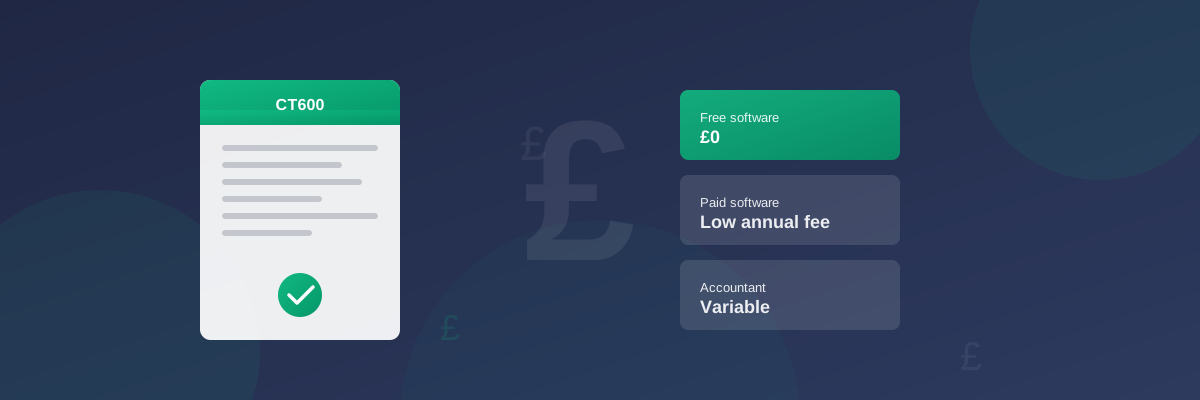
How Much Does It Cost to File Your CT600?
Filing a company tax return — officially known as the CT600 — is a legal requirement for every UK limited company. But the cost varies enormously: some companies pay nothing at all, whilst others pay several hundred pounds a year. The right approach depends on how complex your finances are and how confident you feel handling tax calculations yourself.
This guide breaks down what you can expect to pay and what drives the differences.
What Is the CT600?
The CT600 is the form used to report your company's profits to HMRC and calculate the corporation tax due. Every active limited company must file one within 12 months of the end of its accounting period — even if the company made a loss or has no tax to pay.
Corporation tax rates currently stand at 19% for profits up to £50,000 (the small profits rate) and 25% for profits above £250,000 (the main rate), as verified on GOV.UK. Profits between these figures may attract marginal relief, which tapers the effective rate.
If you're new to the process, start with our complete guide to filing a company tax return.
The Three Ways to File
1. Paying an Accountant
Hiring an accountant to prepare and submit your CT600 is the most common route for small limited companies. Fees depend on several factors:
- Company complexity — a single-director company with simple turnover typically costs less than a business with employees, multiple income streams, or R&D claims
- Whether accounts are included — most accountants price a full package (year-end accounts plus CT600) rather than the return alone
- Accounting software use — if you maintain clean records in Xero, QuickBooks, or FreeAgent, your accountant can work faster, which often reduces the fee
- Location and experience — accountant rates vary considerably across the UK
For help deciding whether an accountant is right for your situation, see Accountant vs DIY CT600 — What Should You Choose?
2. Using CT600 Software
Corporation tax software handles the calculations, generates the required iXBRL accounts, and submits everything directly to HMRC. Costs range from nothing to an annual or per-submission fee.
Free software typically covers dormant company returns, micro-entity accounts, and straightforward trading company scenarios. For many small companies — particularly those filing their first return or with minimal transactions — free tools are entirely adequate. See Free CT600 Filing Options for a current overview.
Paid software offers more advanced features: split-period handling, complex capital allowances, R&D credits, multi-company management, and integrated accounts preparation. Some platforms are designed for accountants managing multiple clients rather than individual directors.
For most small owner-managed companies, it is worth trying free software first. The process is more involved than a personal tax return, but the calculations are automated once you have entered your figures.
3. HMRC's Online Service (Now Closing)
HMRC previously offered a free online filing service that allowed qualifying companies to submit CT600 returns directly. This service is being withdrawn. Companies that have relied on HMRC's own tool will need to switch to HMRC-approved third-party software.
For full details, see HMRC CT600 Service Closing — What You Need to Know and What Replaces HMRC's Free CT600 Service?.
What Makes a CT600 More Expensive to File?
Several factors increase complexity — and therefore cost:
Extended accounting periods
If your company's first accounting period is longer than 12 months, HMRC requires two separate CT600 submissions covering different periods. Accountants and software must handle this split correctly, which adds time and effort.
Capital allowances
Claiming Annual Investment Allowance (AIA) on equipment, vehicles, or machinery — or calculating writing-down allowances on longer-life asset pools — introduces additional calculations. Standard capital allowances are covered by most CT600 software, but complex pools or large purchases may benefit from professional input. See our guide to capital allowances for an overview.
R&D tax credits
If your company qualifies for research and development relief, this requires a separate schedule and significantly increases the return's complexity. This is typically where professional software or an accountant earns its cost.
Associated companies
If you or your shareholders own more than one company, the corporation tax profit thresholds (£50,000 and £250,000) are divided equally among all associated companies. Misreporting this leads to the wrong tax rate being applied — a common error for company owners who have recently set up a second business.
Loss carry-forward
If your company made losses in a previous year, carrying them forward to offset current-year profits requires careful treatment on the CT600. Getting this right can meaningfully reduce your tax bill — see Corporation Tax Losses Explained.
Can You File for Free?
Yes — free CT600 filing is available for many types of company. The situations most commonly handled by free tools include:
- Dormant companies — no trading activity during the period
- Micro-entity companies — small companies below certain size thresholds, filing simplified accounts
- Simple trading companies — owner-managed businesses with standard income and expenses
If you are not sure whether you need to file at all, read Do I Need to File a CT600?
A Rough Cost Guide
Whilst specific fees vary, here is a general framework for thinking about costs:
| Filing route | Typical cost | Best for |
|---|---|---|
| Free CT600 software | £0 | Dormant, micro-entity, simple trading companies |
| Paid CT600 software | Low annual fee | Companies with capital allowances or more complex needs |
| Bookkeeper or tax adviser | Moderate | Companies wanting professional review without full accountant fees |
| Chartered accountant | Higher annual fee | Complex companies, R&D claims, multi-director businesses |
The Cost of Not Filing
The cost of missing the deadline is far greater than the cost of filing on time. HMRC imposes automatic penalties for late CT600 submissions, per GOV.UK:
| Time after deadline | Penalty |
|---|---|
| 1 day late | £200 |
| 3 months late | Additional £200 (total £400) |
| 6 months late | 10% of unpaid tax |
| 12 months late | Further 10% of unpaid tax |
For full details, see CT600 Penalties Explained and Company Tax Return Deadlines.
Summary
The cost of filing a CT600 ranges from free — using HMRC-approved software — to several hundred pounds for an accountant-prepared return. For most small, straightforward limited companies, free software is a practical and sufficient option. Complexity increases cost: extended periods, R&D claims, capital allowances, and associated companies all add to the work involved. Whatever route you choose, meeting the 12-month filing deadline avoids automatic HMRC penalties.