How Much Is Corporation Tax?
Corporation tax is the tax that UK limited companies pay on their profits. Working out how much you owe involves understanding the current rates, which rate applies to your profits, and whether any reliefs or allowances reduce your bill.
This guide covers everything you need to know about the corporation tax amount your company may face — from the basic rates to marginal relief, payment timing, and ways to reduce what you owe.
Current UK Corporation Tax Rates
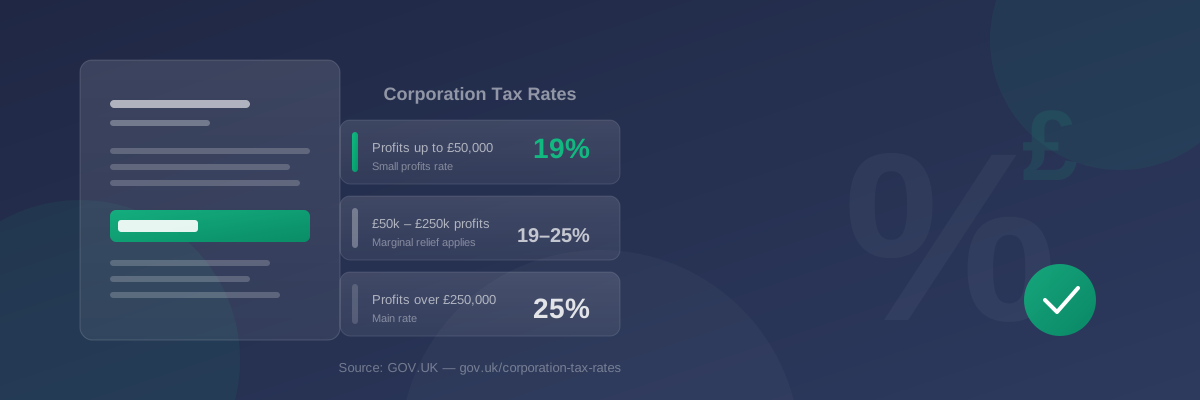
Since 1 April 2023, the UK has had two main corporation tax rates:
| Profits | Rate |
|---|---|
| £50,000 or less | 19% (small profits rate) |
| More than £250,000 | 25% (main rate) |
| Between £50,000 and £250,000 | Between 19% and 25% (marginal relief applies) |
Before 1 April 2023, there was a single flat rate of 19% for all companies regardless of profit level. The introduction of the graduated rate structure means more profitable companies now pay significantly more.
You can verify the current rates at any time on GOV.UK.
How Corporation Tax Is Calculated
Corporation tax is charged on your company's taxable profits. This figure is not the same as your accounting profit — it is adjusted for:
- Disallowable expenses (such as client entertainment, fines, or depreciation)
- Capital allowances (deductions for qualifying assets)
- Any losses brought forward from previous years
- Other reliefs such as R&D tax credits
Taxable profit × Applicable rate = Corporation tax due
Example: Small company
Your company made £35,000 in taxable profits for the year. This falls below the £50,000 lower threshold, so the small profits rate applies:
£35,000 × 19% = £6,650 corporation tax
Example: Larger company
Your company made £400,000 in taxable profits. This exceeds the £250,000 upper threshold, so the main rate applies:
£400,000 × 25% = £100,000 corporation tax
Marginal Relief: When Your Profits Are In Between
If your company's profits fall between £50,000 and £250,000, you do not simply pay 25%. Instead, a relief called marginal relief reduces your tax bill, producing an effective rate somewhere between 19% and 25%.
The relief is calculated using an HMRC formula that takes the difference between the upper limit and your profits, scaled by a marginal relief fraction. As your profits fall towards £50,000, the relief increases and your effective rate drops towards 19%. As your profits approach £250,000, the relief reduces and your effective rate approaches 25%.
In practical terms, the effective corporation tax rate for a company in the marginal relief band:
| Taxable profits | Approximate effective rate |
|---|---|
| £60,000 | ~20.0% |
| £100,000 | ~21.5% |
| £150,000 | ~22.5% |
| £200,000 | ~23.75% |
| £240,000 | ~24.75% |
How the Thresholds Are Adjusted
The £50,000 and £250,000 thresholds are not fixed for every company. Two factors can change them significantly.
Short accounting periods
If your accounting period is less than 12 months — which happens in your company's first year, or after a change of year-end — the thresholds are scaled down proportionately.
A 9-month accounting period, for example, reduces the thresholds to:
- Lower threshold: £37,500 (£50,000 × 9/12)
- Upper threshold: £187,500 (£250,000 × 9/12)
Associated companies
The thresholds are also divided by the number of associated companies. Two companies under common control share the thresholds, so each has a lower threshold of £25,000 and an upper threshold of £125,000.
This matters if you operate through multiple limited companies. A company whose profits look comfortably below £50,000 might find itself in the marginal relief band once the associated company rules are applied.
See our full guide to associated companies and corporation tax for details.
What Reduces Your Corporation Tax Bill?
Several reliefs and allowances can legally reduce the amount of corporation tax your company pays.
Allowable business expenses
Before corporation tax is applied, you can deduct all ordinary business expenses: salaries, rent, software, professional fees, travel, and so on. The higher your deductible expenses, the lower your taxable profit and therefore your tax bill.
Directors' salaries and employer pension contributions are deductible from profits, making pension contributions a particularly tax-efficient way to extract value from your company.
Capital allowances
When you buy equipment, machinery, or vehicles for the business, you can claim capital allowances rather than deducting the cost as a standard expense. The Annual Investment Allowance (AIA) allows you to deduct up to £1 million of qualifying capital spend in a single year, giving 100% first-year relief.
Read more in our guide to capital allowances.
R&D tax credits
If your company carries out qualifying research and development, you may be able to claim R&D tax credits, which can significantly reduce your corporation tax liability — or even result in a repayable credit for loss-making companies.
Corporation tax losses
If your company makes a loss in a given period, you can carry it forward to offset against future profits, carry it back against the previous year, or in some cases surrender it within a group.
This means a difficult year does not necessarily result in wasted losses — they can reduce your tax bill in better years. For details, see our guide to corporation tax losses.
When Is Corporation Tax Due?
Corporation tax is typically due nine months and one day after the end of your accounting period.
| Accounting period ends | Corporation tax due by |
|---|---|
| 31 March | 1 January |
| 30 June | 1 April |
| 31 December | 1 October |
Large companies with profits above £1.5 million pay in quarterly instalment payments (QIPs) during the accounting period itself, rather than after it ends.
Filing Your Company Tax Return
You must file a company tax return (CT600) with HMRC within 12 months of the end of your accounting period, even if you have no tax to pay. The CT600 calculates your tax liability, records your income and reliefs, and confirms your payment.
Your company tax return must be filed online using commercial software — HMRC no longer accepts paper returns.
To get an estimate of your corporation tax before you file, try our corporation tax calculator.
Summary
Corporation tax in the UK is 19% for profits up to £50,000 and 25% for profits above £250,000, with marginal relief applying for profits in between. The thresholds are scaled for short accounting periods and divided between associated companies. Reliefs including capital allowances, R&D credits, and loss relief can reduce your final bill. Payment is due nine months and one day after your accounting period ends.