Dividend vs Salary Calculator: How to Pay Yourself Tax-Efficiently
If you run a limited company, one of the most important financial decisions you face is how to pay yourself. Most company directors choose a combination of salary and dividends — but getting the balance right can significantly reduce your overall tax bill.
This guide explains the key tax factors to consider when deciding between salary and dividends, including how your choice affects corporation tax, national insurance, and personal income tax.
Why the Salary vs Dividend Decision Matters
As a company director and shareholder, you typically have flexibility in how you extract money from your company. The two main options are:
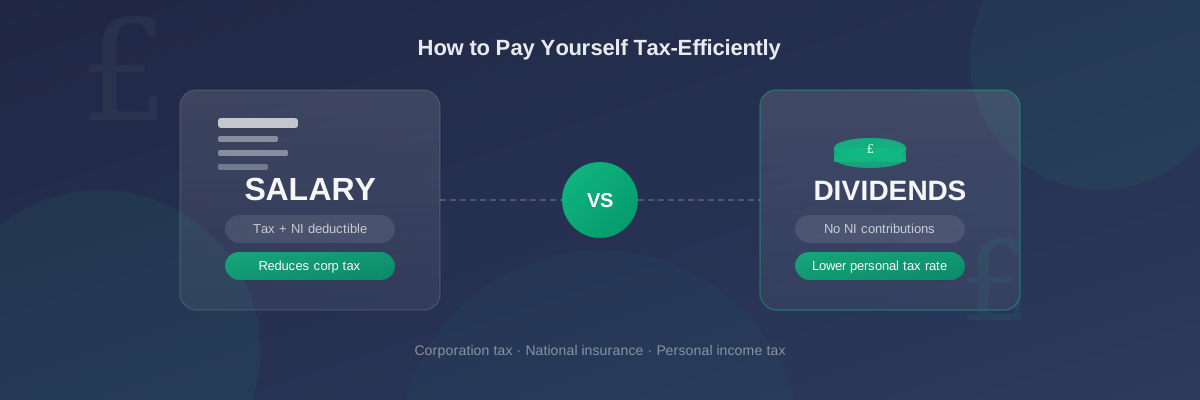
- Salary — paid through PAYE, subject to income tax and national insurance contributions (NICs)
- Dividends — paid from post-tax profits, subject to dividend tax but not NICs
Understanding how these two interact is essential for tax-efficient planning.
How Corporation Tax Affects the Calculation
Your company pays corporation tax on its taxable profit. The current rates are:
- 19% on profits up to £50,000 (small profits rate)
- 25% on profits over £250,000 (main rate)
- A tapering marginal relief applies to profits between £50,000 and £250,000
Dividends do not reduce corporation tax — they are paid from profits on which corporation tax has already been paid. See our corporation tax rates guide for the full breakdown.
National Insurance Contributions
One of the main reasons many directors favour dividends over salary is national insurance contributions. Both employer and employee NICs apply to salary above the relevant thresholds, but dividends are not subject to NICs at all.
From April 2025, the employer NICs rate is 15% on earnings above the secondary threshold (£5,000 per year). Employee NICs apply at 8% on earnings between the primary threshold and the upper earnings limit (approximately £12,570 to £50,270 for 2025/26).
This means a high salary carries a significant NI cost on top of income tax. Dividends avoid this entirely, which is why many directors take a modest salary and top up with dividends.
Personal Tax on Dividends vs Salary
Salary is taxed at standard income tax rates:
- 20% basic rate (income £12,571–£50,270)
- 40% higher rate (income £50,271–£125,140)
- 45% additional rate (income over £125,140)
- 8.75% (basic rate taxpayer)
- 33.75% (higher rate taxpayer)
- 39.35% (additional rate taxpayer)
The Typical Optimal Approach
For most owner-managed companies, the tax-efficient approach is:
- Pay a salary up to the NI primary threshold — this avoids NICs while still qualifying as a national insurance year for state pension purposes. For 2025/26 this is approximately £12,570.
- Top up with dividends — using the dividend allowance first, then at the applicable dividend tax rate.
- Use the personal allowance efficiently — ensure the salary uses up part or all of the personal allowance (£12,570 for 2025/26).
The exact optimal split depends on your company's profit level, whether you have other income, whether you are affected by marginal relief, and your personal tax position.
When the Corporation Tax Rate Changes the Picture
The corporation tax rate you pay affects how much the salary deduction is worth. If your company pays the 25% main rate, the corporation tax saving from salary is higher — making salary relatively more attractive compared to dividends.
If your company pays the 19% small profits rate, the saving is lower, so dividends may be more tax-efficient overall.
If your profits fall in the marginal relief band (£50,000–£250,000), the effective marginal rate of corporation tax can be higher than 25% — making salary deductions especially valuable in some circumstances. Read our marginal relief guide for a detailed explanation.
Other Factors to Consider
Pension Contributions
Employer pension contributions are another tax-efficient alternative to both salary and dividends. Like salary, they are a deductible business expense that reduces your company's corporation tax. But unlike salary, they do not attract NICs and do not count as personal income in the year of payment.
For directors who do not need cash immediately, employer pension contributions can be more efficient than either salary or dividends — particularly for higher-rate taxpayers.
Retained Profits
Not all profit needs to be extracted from the company each year. Retaining some profit in the company can defer personal tax until a future year when your tax position may be more favourable — for example, a year with lower income or different tax rates.
IR35 and Off-Payroll Rules
If your company's contracts are subject to IR35 (off-payroll working rules), a deemed salary calculation may apply. This significantly changes the salary vs dividend calculation, as income from affected contracts is treated as employment income for tax purposes.
If you are uncertain whether IR35 applies to your contracts, seek specialist advice before making remuneration decisions.
Loss Years
If your company makes a trading loss in a particular year, dividend payments may not be possible — dividends can only be paid from distributable (post-tax) profit, not from capital. Salary can still be paid and may create or increase a loss that is available to carry forward against future profits.
See our corporation tax losses guide for more on how losses work on the company tax return.
How Salary Appears on the CT600
Salary and employer NI contributions appear in your profit and loss account as deductible expenses, reducing the taxable profit that flows into the company tax return.
Dividends are not shown on the CT600 — they are a distribution of post-tax profit and appear only on the balance sheet as a reduction in distributable reserves.
When you import your trial balance into TinyTax, the salary deduction is automatically included in the adjusted profit figure. Dividends paid during the year do not affect your tax calculation on the CT600.
Summary
The most tax-efficient approach for most company directors is a combination of salary and dividends — typically a salary up to the NI threshold (approximately £12,570), with additional income taken as dividends. The exact balance depends on your company's corporation tax rate, your personal income, and whether marginal relief applies.
For corporation tax planning, the key point is that salary reduces your company's taxable profit (and therefore its corporation tax bill), while dividends do not. Use our corporation tax calculator to estimate your company's tax liability at different profit levels before deciding how much to extract.
Corporation tax rates and NI thresholds are set by HMRC and may change. Always verify current figures at GOV.UK before making remuneration decisions.