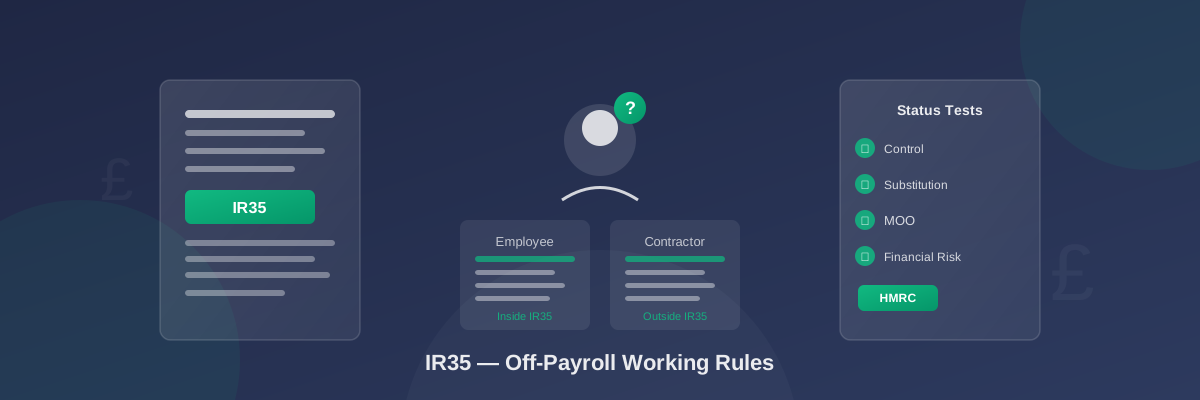
What Is IR35? Off-Payroll Working Explained
If you work through your own limited company as a contractor or freelancer, IR35 is one of the most important pieces of legislation you need to understand. Get it wrong and you could face a significant tax bill; get it right and you can operate with confidence as a genuine independent contractor.
IR35 refers to the off-payroll working rules that HMRC uses to determine whether a contractor providing services through their own intermediary — usually a personal service company (PSC) — should be taxed in the same way as an employee.
If IR35 applies to your contract, you pay broadly the same income tax and National Insurance contributions as an employee would, even though you work through your own company. If IR35 does not apply, you retain the tax advantages of running your own company and can pay yourself through a combination of salary and dividends.
Key takeaways
- IR35 applies when a contractor working through their own company would be considered an employee if they engaged the client directly
- Being inside IR35 means you are taxed as an employee — income tax and National Insurance are deducted at source
- Being outside IR35 means you can pay yourself through salary and dividends from your own company
- Since April 2021, large and medium private sector clients are responsible for determining your IR35 status
- Your status is assessed contract by contract, not company by company
What Is IR35?
IR35 is shorthand for Chapter 8 of the Income Tax (Earnings and Pensions) Act 2003 and the off-payroll working rules introduced by HMRC to tackle what they call "disguised employment." The rules were originally introduced in 2000 following Inland Revenue Press Release IR35 — hence the name that has stuck.
The core question IR35 asks is this: if you removed the intermediary (your limited company) and the worker provided services directly to the client, would they be an employee? If the answer is yes, IR35 applies and you should be paying broadly the same income tax and National Insurance as an employee would.
Why Does IR35 Exist?
IR35 exists because HMRC identified a growing practice of workers effectively operating as employees — working for a single client, under the client's direction, for extended periods — but doing so through a limited company to reduce their tax bill. By routing income through a company, contractors could pay corporation tax on profits, then take dividends rather than salary, avoiding substantial amounts of income tax and National Insurance.
HMRC's position is straightforward: if a working arrangement looks like employment, it should be taxed like employment.
How Is IR35 Status Determined?
There is no single test that decides IR35 status. Instead, HMRC and the courts look at the overall working relationship — the actual day-to-day reality of the arrangement, not just what a contract says on paper.
The main factors considered are:
Is There Mutuality of Obligation?
Mutuality of obligation (MOO) asks whether the client is obliged to offer work and the worker is obliged to accept it. In a genuine employment relationship, the employer provides work and the employee turns up. Genuine contractors are typically engaged for specific projects with no obligation on either side to continue the relationship once the project ends.
Does the Client Have Control?
Control examines whether the client dictates how, when, and where the work is done. Employees are typically told how to carry out their duties. Independent contractors are usually given a result to achieve and left to determine how to achieve it. If a client controls the method of working in detail, that points towards employment.
Is There a Right of Substitution?
A contractor's ability to send a substitute to carry out the work — rather than attending personally — is a strong indicator of genuine self-employment. If the client insists on personal service and would not accept a qualified substitute, that points towards a disguised employment arrangement.
Other Factors HMRC Considers
Beyond the three main tests, HMRC also examines:
- Whether the worker provides their own equipment and tools
- Whether the worker takes genuine financial risk (such as fixing prices upfront and bearing the cost of correcting mistakes)
- Whether the worker works for multiple clients simultaneously
- How integrated the worker is into the client's organisation (using client email addresses, appearing on the company intranet, attending company events as staff)
- The length of the engagement and whether there is a fixed project or ongoing open-ended work
Who Is Responsible for Determining IR35 Status?
Who bears responsibility for the IR35 assessment depends on the size of the end client.
Large and Medium Private Sector Clients (Since April 2021)
Since April 2021, medium and large private sector companies have been responsible for determining the IR35 status of contractors they engage. Before this reform, the contractor's own company was responsible for the assessment in private sector engagements.
A company is classified as medium or large if it meets at least two of the following:
- Annual turnover over £10.2 million
- Balance sheet total over £5.1 million
- More than 50 employees
Public Sector Clients (Since April 2017)
Public sector bodies — including central government departments, NHS trusts, and local authorities — have been responsible for IR35 status determinations since April 2017.
Small Private Sector Clients
If you are working for a small private sector company, the original rules still apply — your own limited company is responsible for determining its IR35 status for that engagement.
What Happens When a Contract Is Inside IR35?
If a contract is determined to be inside IR35, the deemed employer — typically the fee-payer in the chain, often an agency — must deduct income tax and employee National Insurance contributions from the fees before paying them to your company. The deemed employer also pays employer NICs on top.
Your company receives a net payment, in much the same way an employee receives a net salary after PAYE deductions. The full employment taxes are paid over before the money reaches you.
The practical effect is significant. You lose the tax advantages of running a company for that contract — you cannot take dividends from those earnings at a lower rate. Income tax and NICs are payable at employment rates.
You can still make certain deductions through your company (for example, pension contributions), but the scope for tax efficiency is considerably reduced compared with an outside IR35 contract.
What Happens When a Contract Is Outside IR35?
If a contract is outside IR35, you operate as a genuinely independent contractor. Your company receives the full contract fee. You then pay yourself through a combination of salary and dividends in the most tax-efficient way.
For most contractor-directors, this means paying a low salary (often set at or near the National Insurance threshold) and then drawing additional income as dividends, which are taxed at lower rates than employment income.
See our guide to how to pay yourself from a limited company for a full breakdown of salary and dividend strategies available to directors.
Outside IR35 contracts also preserve your company's eligibility for other tax planning strategies, such as pension contributions made by the employer (your company), which reduce corporation tax.
The 2021 Off-Payroll Working Reforms
The most significant recent development in IR35 was the extension of the off-payroll working rules to the private sector in April 2021 (originally scheduled for April 2020, then delayed by one year due to the COVID-19 pandemic).
Before April 2021, contractors were responsible for assessing their own status in private sector engagements. Many incorrectly assessed themselves as outside IR35, and HMRC believed significant tax was being lost as a result.
After April 2021, medium and large private sector clients took on responsibility for the determination. This prompted many large businesses to conduct blanket assessments of their contractor workforce — and, in some cases, to issue blanket inside IR35 decisions regardless of the actual working arrangements.
HMRC has explicitly stated that blanket determinations are not acceptable. Each contract must be assessed individually on its own facts.
Challenging an IR35 Decision
If a medium or large client issues an inside IR35 Status Determination Statement and you believe it is incorrect, you have the right to raise a formal disagreement. The client must consider your challenge and provide a written response within 45 days.
If the client upholds the inside IR35 decision and you remain unhappy, you can seek specialist advice from an IR35 tax adviser or employment lawyer, or in some circumstances take the matter further through the employment tribunal system.
Keeping detailed records of your actual working practices — not just what the contract says — is important if you need to support a challenge.
Common Misconceptions About IR35
"My contract says I'm outside IR35"
HMRC looks at the actual working arrangements, not just what the contract states. A contract that grants a right of substitution means little if in practice you have always attended personally and the client would not accept anyone else. The contract must reflect reality.
"Working through an agency means IR35 doesn't apply"
IR35 applies whenever services are provided through an intermediary, including arrangements that involve agencies. When the end client determines inside IR35 status, the agency typically becomes the deemed employer responsible for deducting tax.
"Working for multiple clients means I'm automatically outside IR35"
Working for multiple clients simultaneously is a factor that suggests genuine self-employment, but it is not conclusive on its own. HMRC looks at all the circumstances together.
"IR35 only affects IT contractors"
IR35 applies across all industries. Engineers, management consultants, finance professionals, marketing specialists, project managers, and any other worker providing services through a personal service company can be caught by the rules.
IR35 and Your Company's Other Tax Obligations
Regardless of IR35 status, your limited company must still file a company tax return (CT600) with HMRC each year and pay corporation tax on any profits it retains. If all your contracts are inside IR35, your company may make little or no profit — but the filing obligation remains.
As a company director, you must also file a Self Assessment tax return each year to report dividends, interest, and any other income not taxed at source. For a full breakdown of what directors need to report, see our Self Assessment guide for company directors.
If your company pays you a salary and you employ other people, you will also need to run payroll and operate PAYE. See our guide to hiring your first employee if you are considering taking on staff.
Frequently Asked Questions
What does IR35 mean in plain English?
IR35 is a set of HMRC tax rules that prevent workers from reducing their tax bill by providing services through a limited company when they are, in reality, working as employees. If the rules apply to your contract, you pay the same income tax and National Insurance as an employee — even though you work through your own company.
Who decides if I am inside or outside IR35?
It depends on your client's size. If your client is a large or medium private sector company, or any public sector body, they must determine your IR35 status and provide a Status Determination Statement. If your client is a small private sector company, your own limited company determines your status for that engagement.
Can I appeal an inside IR35 decision?
Yes. If a medium or large client determines your contract is inside IR35, you can raise a formal disagreement. The client must consider it and respond in writing within 45 days. If you remain unsatisfied, specialist tax advice or, in some cases, an employment tribunal can be pursued.
What is the CEST tool?
CEST (Check Employment Status for Tax) is an online tool provided by HMRC that asks questions about your working arrangement and gives an indicative view on IR35 status. It is not legally binding and has attracted criticism for omitting some key tests, but it can serve as a useful starting point for a status assessment.
Do I still need to file a CT600 if all my contracts are inside IR35?
Yes. Your limited company still needs to file a company tax return with HMRC every year, even if all contracts are inside IR35 and the company makes no profit after the deemed salary payments. The filing obligation exists regardless of profitability.
Summary
IR35 is one of the most significant tax rules affecting UK contractors and freelancers who work through limited companies. Being inside IR35 means you are taxed as an employee and lose the tax advantages of running your own company. Being outside IR35 preserves those advantages. Since the 2021 reforms, medium and large private sector clients now determine your status — but understanding the rules yourself remains essential to protecting your position, challenging incorrect decisions, and structuring your working arrangements correctly.