What Is Corporation Tax?
Corporation tax is the tax that UK limited companies pay on their profits. If your company earned a profit during its financial year, it will owe corporation tax to HMRC — and it must file a company tax return to report those profits, even if no tax is ultimately due.
Corporation tax is separate from income tax (which individuals pay on their earnings) and VAT (which is charged on sales). Understanding how it works is one of the most important things for any new company director.
Who Pays Corporation Tax?
Corporation tax applies to:
- UK limited companies (the most common case)
- Foreign companies with a permanent establishment in the UK
- Clubs, co-operatives, and some unincorporated associations
Current Corporation Tax Rates
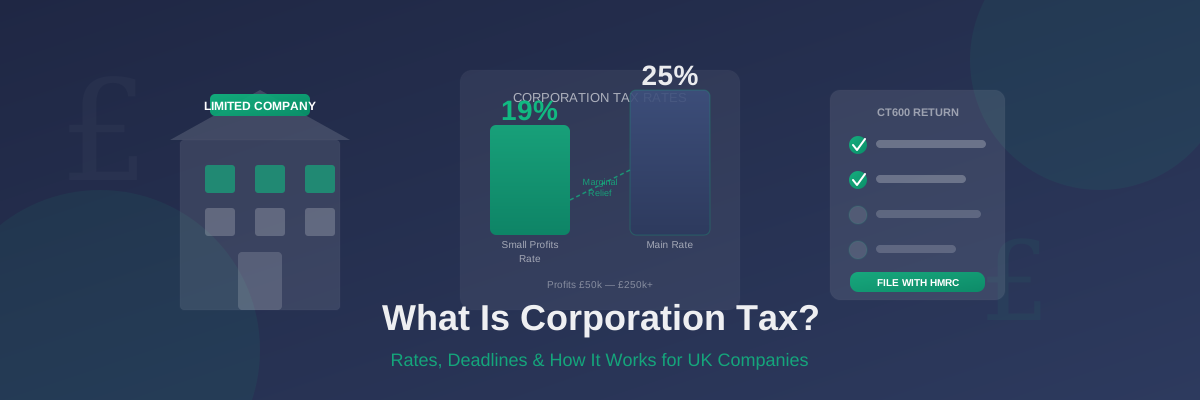
From 1 April 2023, the UK operates a two-rate system for corporation tax, with a tapering mechanism for companies in between:
| Profit level | Rate |
|---|---|
| £50,000 or less | 19% (small profits rate) |
| Between £50,001 and £250,000 | Tapered via marginal relief |
| Over £250,000 | 25% (main rate) |
Small profits rate (19%): Companies with profits of £50,000 or less pay at the small profits rate of 19%.
Main rate (25%): Companies with profits over £250,000 pay at the full main rate of 25%.
Marginal relief: For profits between £50,000 and £250,000, companies can claim marginal relief, which gradually increases the effective tax rate from 19% to 25%. For a detailed explanation of how this works, see our guide to marginal relief and corporation tax.
Threshold Adjustments
The £50,000 and £250,000 thresholds are not fixed for every company. They are adjusted in two situations:
Short accounting periods: If your company's accounting period is less than 12 months — common in the first year of trading — the thresholds are reduced proportionally. A six-month period uses thresholds of £25,000 and £125,000.
Associated companies: If your company has associated companies (broadly, companies under the same control), the thresholds are divided equally between all of them. With two associated companies, each uses thresholds of £25,000 and £125,000.
What Is Taxed?
Corporation tax is charged on your company's taxable profits, broadly calculated as:
Turnover minus allowable business expenses minus capital allowances minus loss reliefs applied = taxable profit
Not all business costs are allowable for corporation tax. HMRC has specific rules:
Allowable expenses include: salaries and employer National Insurance, rent and utilities, business travel, professional fees, software subscriptions, and marketing costs.
Non-allowable expenses include: entertaining clients, fines and penalties, and accounting depreciation (which is replaced by capital allowances under the tax rules).
Capital allowances let companies deduct the cost of equipment, machinery, and vehicles from taxable profits. The Annual Investment Allowance (AIA) allows most companies to deduct the full cost of most qualifying assets in the year of purchase, up to the current AIA limit.
When Is Corporation Tax Due?
Corporation tax operates on two separate deadlines:
Tax payment deadline: 9 months and one day after the end of your accounting period. For a company with a 31 March year-end, this is 1 January of the following year.
Filing deadline (CT600 return): 12 months after the end of your accounting period. For a 31 March year-end, this is 31 March of the following year.
The payment deadline falls three months before the filing deadline. This means you need to estimate and pay your tax before you formally submit your return. Most companies calculate this from their draft accounts and adjust later if needed.
For a full breakdown of dates by accounting year-end, read our guide to company tax return deadlines.
What Is a Company Tax Return?
The company tax return — officially known as a CT600 — is the document your company files with HMRC to report its profits and calculate corporation tax. It is submitted electronically, either through HMRC's own online service or via approved third-party software.
Alongside the CT600, you must submit:
- Your company's accounts (profit and loss account and balance sheet) formatted in iXBRL — a special digital format HMRC requires
- A tax computation showing how taxable profit was derived from accounting profit
For a complete walkthrough of the filing process, see our guide to filing your company tax return.
Does My Company Have to File Even With No Profit?
Yes. HMRC requires every company registered for corporation tax to file a return for every accounting period — even if:
- Your company made a loss (you still file; losses can be carried forward to reduce future profits)
- Your company had no income (a nil return is still required)
- Your company is dormant (no trading activity)
Penalties for Late Filing or Late Payment
Late filing penalties:
- £200 penalty if the return is one day late
- A further £200 if still outstanding after three months (total £400)
- Additional tax-based penalties if the return is more than six months late
Filing on time — even if you cannot pay immediately — limits the total penalties you face. For a full breakdown of what to expect, see our guide to CT600 penalties.
How to Pay Corporation Tax
Once you have calculated your liability, you pay HMRC directly using your company's Unique Taxpayer Reference (UTR) as the payment reference. Accepted payment methods include:
- Online banking or BACS (most common)
- Faster Payments
- CHAPS (for same-day, urgent payments)
Corporation Tax, Salary, and Dividends
Corporation tax is paid by the company on its profits. When a director takes money from the company, there are two main routes, each treated differently:
Salary: Paid as an allowable business expense, which reduces the company's taxable profit and therefore its corporation tax bill. The director pays income tax and National Insurance personally on the salary received.
Dividends: Paid from the company's after-tax profits — so they do not reduce the corporation tax bill. The director pays dividend tax personally on dividends above the annual dividend allowance.
Understanding this distinction is important for structuring how you draw income from your company in a tax-efficient way.
Summary
Corporation tax is charged on the profits of UK limited companies at rates between 19% and 25%, depending on the level of profits. Every company must file a CT600 return each year and pay any tax due within nine months and one day of the period end — even if the company made no profit. Getting the basics right from the outset sets your company up for compliant, stress-free filing every year.