Transferring a Sole Trade Into a Limited Company
When you decide to incorporate, you have a choice: close your sole trade and start fresh with a new company, or formally transfer your existing business — including its assets, goodwill, and liabilities — into the limited company. This second approach, known as a business transfer on incorporation, has specific tax implications you need to understand before proceeding.
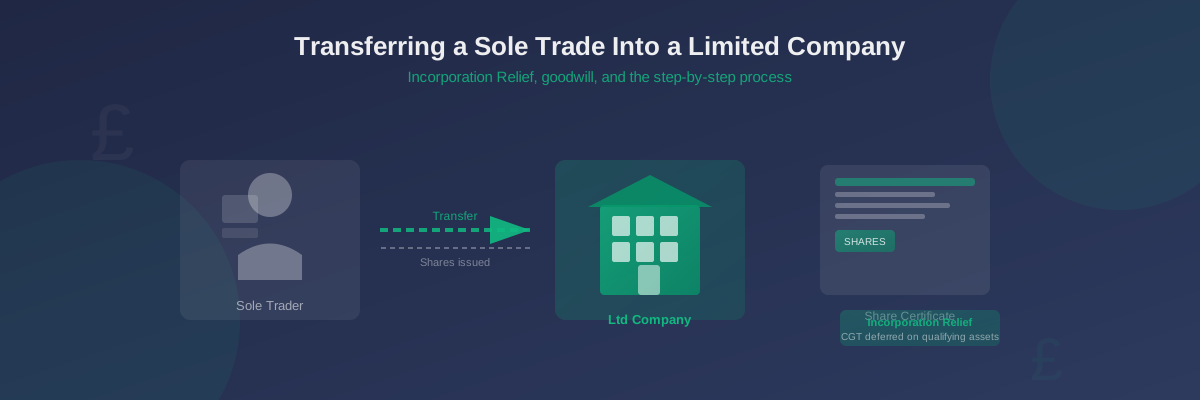
Transferring your sole trade into a limited company means the company acquires your business assets in exchange for shares. If done correctly, Incorporation Relief can defer any capital gains tax on business goodwill and other chargeable assets until you eventually sell your shares.
Key takeaways
- Transferring a sole trade means the limited company buys your business assets in exchange for shares in the company
- Incorporation Relief automatically defers capital gains tax on qualifying assets when you transfer the whole business (excluding cash) for shares — per GOV.UK
- If you receive any cash alongside shares, CGT on the cash portion is payable straight away
- You must notify HMRC you have stopped being self-employed and register the company for corporation tax separately
- Goodwill is often the largest asset transferred — seek professional advice on its valuation and tax treatment before proceeding
What does transferring a sole trade mean?
A business transfer on incorporation is a formal arrangement where your new limited company takes over your business. The company acquires the assets — equipment, stock, work in progress, goodwill, and trade debtors — in exchange for issuing you shares equal to their combined value.
This is different from simply stopping your sole trade and starting fresh with a clean company. In a transfer, the company inherits the business as a going concern, often with the same clients, contracts, and trading name.
For a full comparison of the two structures, read Sole Trader vs Limited Company: Which Is Better?.
What is Incorporation Relief and when does it apply?
Incorporation Relief (TCGA 1992 s162) allows you to defer capital gains tax that would otherwise arise when you transfer chargeable assets — such as goodwill — to a limited company. Without relief, transferring business goodwill at a gain would trigger an immediate CGT charge in your Self Assessment return.
According to GOV.UK, to qualify automatically:
- You must be a sole trader (or business partner)
- You must transfer the business and all its assets (except cash) to the company
- You must receive shares in the company in return
No claim needed: Incorporation Relief applies automatically if you meet the conditions. You can opt out by contacting HMRC — for example, if you prefer to crystallise gains now while a lower rate applies.
What happens if I receive cash as well as shares?
If the company pays you a mixture of shares and cash, relief applies only proportionally. The cash portion is treated as a disposal at market value, and you must pay CGT on any gain attributable to that cash in your next Self Assessment return.
For example: if your business assets are worth £100,000 and you receive 80% in shares and 20% in cash, you can defer 80% of the gain but must pay CGT on the remaining 20% immediately.
What assets are transferred?
Typical assets included in a sole trade transfer are:
- Goodwill — the value of your business reputation, client relationships, and ongoing contracts
- Equipment and tools — at their current market value (not original cost)
- Trading stock and work in progress
- Trade debtors — money owed to the business at the transfer date
- Contracts and leases — subject to counterparty consent
Capital allowances and trading stock
Transferring assets to a company has specific capital allowances consequences:
- Plant and machinery: You are treated as selling the assets to the company at the agreed transfer price. The company starts with a cost base equal to the transfer value. Electing the right transfer price can avoid a capital allowances balancing charge arising for you personally.
- Trading stock: Normally valued at market value for transfer purposes. You and the company can jointly elect to use the lower of cost or market value, deferring any profit into the company.
Tax treatment of goodwill
Goodwill is often the most valuable and most complex asset in a sole trader business — particularly for consultants, tradespeople, and professional services firms. It represents the value of client relationships and business reputation built up over time.
When you transfer goodwill to your company:
- You may have a capital gain equal to its market value at transfer (most pre-incorporation goodwill has a nil cost base, so the full value is a gain)
- Incorporation Relief defers this gain until you sell your shares
- The company receives a cost base in the goodwill equal to its market value at transfer
How to carry out the transfer in practice
Steps
- Value your business assets — including goodwill — at the date of transfer. A formal professional valuation is advisable for HMRC purposes if significant goodwill is involved
- Incorporate the limited company (see How to Register a Limited Company in the UK)
- Prepare a business transfer agreement between yourself and the company, listing all assets and their agreed transfer values
- Issue shares to yourself equal in value to the net assets transferred (assets minus liabilities assumed)
- Notify HMRC that you have ceased self-employment via your Self Assessment account
- Register the company for corporation tax with HMRC within 3 months of starting to trade
- Inform key clients, suppliers, and HMRC of the company's details and VAT number
What about VAT?
If your sole trade is VAT-registered, you can transfer the VAT registration to the new company as a Transfer of a Going Concern (TOGC). This avoids VAT being charged on the sale of business assets and keeps the existing VAT number. You need to apply to HMRC for the transfer of the VAT registration — do this before completing the transfer.
What tax do I report personally after incorporating?
After incorporating, you must still file a Self Assessment tax return covering the final tax year (or period) of your sole trade. This includes:
- Trading profits up to the date of cessation
- Any capital gains not deferred by Incorporation Relief (e.g. the cash element of any mixed consideration)
- Dividends received from the company in the same tax year
Frequently Asked Questions
Do I have to pay capital gains tax when I transfer my sole trade to a limited company?
Not immediately, if you qualify for Incorporation Relief. The relief automatically defers CGT on chargeable assets (such as goodwill) when you transfer the whole business in exchange for shares. CGT becomes due when you eventually sell your shares. If you receive cash alongside shares, CGT on the cash portion is payable in your next Self Assessment return.
How is goodwill valued when transferring a sole trade?
Goodwill is typically valued using a multiple of maintainable profits or a percentage of annual turnover, depending on the industry. HMRC expects an arm's-length valuation for significant goodwill transfers — a formal professional valuation reduces the risk of challenge. Some trades (e.g. sole trader builders with few repeat clients) have minimal transferable goodwill; others (e.g. accountants, solicitors) may have substantial amounts.
Can I transfer my sole trader debts to the company?
The company can assume your business debts as part of the transfer agreement. However, the liabilities assumed reduce the net consideration you are treated as receiving, which affects the Incorporation Relief calculation. Personal debts unrelated to the business remain with you personally.
Do I need a solicitor to transfer a sole trade into a company?
You are not legally required to use a solicitor, but a properly drafted business transfer agreement is strongly recommended for any business with significant assets or goodwill. Many accountants can assist with the documentation. For complex transfers involving property or regulated contracts, professional legal advice is essential.
What happens to my existing contracts when I incorporate?
Contracts are generally personal to the contracting party. To transfer them to the company, you normally need the consent of the other party. In practice, most clients are willing to novate contracts to the new company. Review the terms of each significant contract and inform key clients before completing the transfer.
Summary
Transferring your sole trade into a limited company can be highly tax-efficient when structured correctly. Incorporation Relief automatically defers capital gains tax on business assets (except cash) when you exchange the whole business for shares. However, the rules around goodwill amortisation relief in the company, mixed consideration, and capital allowances elections have changed significantly in recent years — professional advice before incorporating will help you structure the transfer to minimise tax and administrative complications.