Am I a Micro-Entity? How to Check Your Company's Qualification
A micro-entity is the smallest category of UK limited company under the Companies Act 2006. Qualifying as one can significantly simplify your filing obligations at Companies House — you may be able to file just a balance sheet rather than a full set of accounts.
This guide explains the micro-entity thresholds, how to check whether your company qualifies, what accounts you can file if it does, and how micro-entity status compares to small company status.
What Is a Micro-Entity?
Micro-entity status is a legal classification for the very smallest limited companies, introduced to reduce the administrative burden on companies that are genuinely small — typically sole-director businesses, holding companies with minimal activity, or simple service companies.
Being a micro-entity does not change your corporation tax obligations. You still need to file a company tax return (CT600) with HMRC and prepare full statutory accounts. The simplification applies only to what you send to Companies House.
The Three Micro-Entity Thresholds
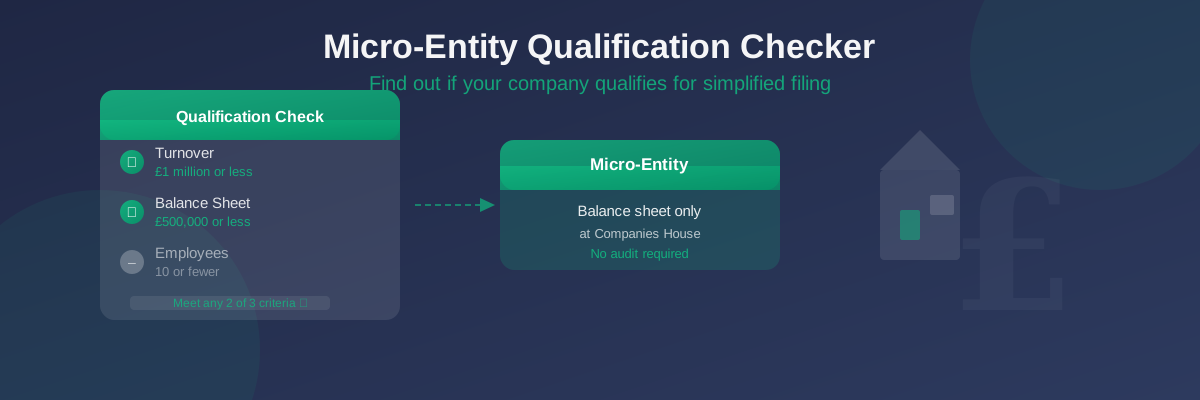
Your company qualifies as a micro-entity if it meets any two of these three criteria:
| Criterion | Micro-entity threshold |
|---|---|
| Turnover | £1 million or less |
| Balance sheet total | £500,000 or less |
| Number of employees | 10 or fewer |
You only need to satisfy two out of three. A company with £900,000 turnover and 8 employees qualifies even if its balance sheet exceeds £500,000.
How to Check: A Simple Decision Tree
Work through these questions in order.
Step 1: Do you meet at least 2 of the 3 criteria above?
- No → You are not a micro-entity. Check small company status below.
- Yes → Continue to Step 2.
Some companies cannot use the micro-entity regime even if they meet the size thresholds:
- Public limited companies (PLCs)
- Banks, building societies, and credit institutions
- Insurance companies
- Companies that are part of a group containing an ineligible entity
- LLPs (separate rules apply under different regulations)
- Yes (ineligible) → Micro-entity accounts are not available to you.
- No → Continue to Step 3.
For an established company, you must meet the micro-entity thresholds in two consecutive financial years before switching to the micro-entity regime. Newly incorporated companies can use it from their first year if they qualify.
- First year of qualification → You can use micro-entity accounts from next year.
- Second consecutive year → You qualify now.
- Previously qualified but now failing → You retain micro-entity status for one more year before losing it.
Practical Examples
Example 1: Sole-director consulting company
- Turnover: £85,000
- Balance sheet: £12,000
- Employees: 1
Example 2: Small property holding company
- Turnover: £0 (no trading income)
- Balance sheet: £450,000 (property asset)
- Employees: 0
Example 3: Growing e-commerce business
- Turnover: £1.2 million
- Balance sheet: £380,000
- Employees: 7
Example 4: Mid-size agency
- Turnover: £3.5 million
- Balance sheet: £900,000
- Employees: 22
What Can Micro-Entities File?
If your company qualifies, you can file micro-entity accounts with Companies House. These are significantly simpler:
- Balance sheet only — no profit and loss account required in the public filing
- Fewer notes — disclosure requirements are minimal compared to full accounts
- No directors' report required in the Companies House filing
- No audit required — micro-entities are automatically audit-exempt (subject to the usual independence conditions)
For a detailed walkthrough of what micro-entity accounts must contain, see our micro-entity accounts guide.
Micro-Entity vs Small Company: What's the Difference?
Many directors are unsure which category applies to them. Here is a side-by-side comparison:
| Micro-entity | Small company | Standard | |
|---|---|---|---|
| Max turnover | £1 million | £15 million | Above £15m |
| Max balance sheet | £500,000 | £7.5 million | Above £7.5m |
| Max employees | 10 | 50 | Above 50 |
| Criteria needed | Any 2 of 3 | Any 2 of 3 | Fails small test |
| Companies House filing | Balance sheet only | Abridged or full | Full accounts |
| P&L required at CH | No | No (optional) | Yes |
| Audit exempt | Yes (conditions apply) | Yes (conditions apply) | No |
If you exceed the micro-entity thresholds but not the small company thresholds, you still benefit from some simplifications — including the option to file abridged accounts and the audit exemption.
What Counts as Turnover?
For the purpose of these thresholds, turnover means your company's revenue from its ordinary activities — sales, fees, or rental income from the company's main trading activity. It does not include:
- Capital gains on the disposal of assets
- VAT (turnover is measured net of VAT)
- Dividends received by a holding company from subsidiaries
Does Micro-Entity Status Affect Corporation Tax?
No. Micro-entity status is purely a Companies House classification. It has no effect on:
- How your taxable profits are calculated
- Your corporation tax rate
- Your CT600 filing obligations with HMRC
- Capital allowances, loss relief, or any other tax position
What About Dormant Companies?
Dormant companies have their own separate rules. A dormant company can file dormant accounts with Companies House regardless of its size — it does not need to meet the micro-entity thresholds. See our dormant company accounts guide for more detail on what counts as dormant and what you need to file.
Summary
Your company qualifies as a micro-entity if it meets any two of the three thresholds: turnover of £1 million or less, balance sheet of £500,000 or less, or 10 or fewer employees. Qualifying lets you file just a balance sheet with Companies House, significantly simplifying your public disclosure obligations. However, micro-entity status has no impact on your corporation tax or CT600 requirements — HMRC receives the same information regardless of your size category.