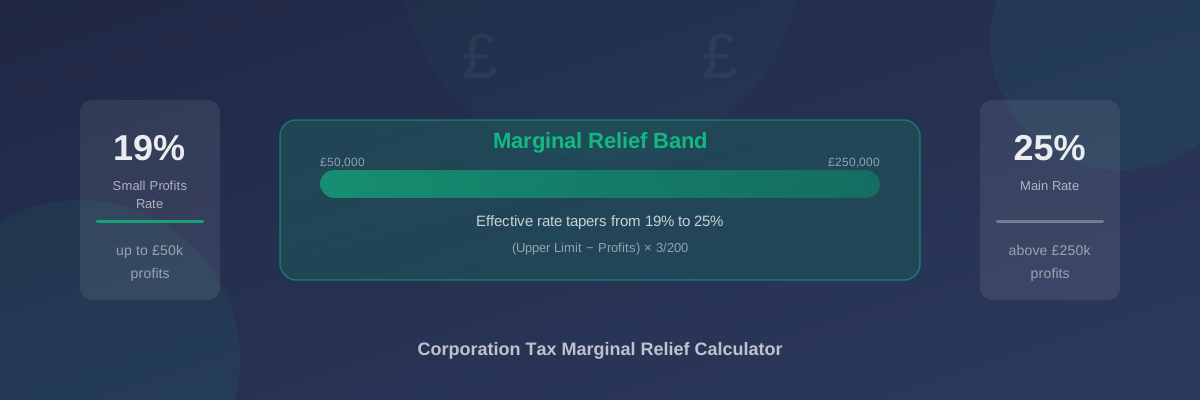
Marginal Relief Calculator for Corporation Tax
If your company's taxable profits fall between £50,000 and £250,000, you may qualify for marginal relief — a reduction that brings your effective corporation tax rate below the 25% main rate. This guide explains how marginal relief is calculated, walks through worked examples, and shows you how to work out your company's relief using the official HMRC formula.
What Is Marginal Relief?
Since 1 April 2023, UK corporation tax operates on a two-rate system:
- Small profits rate: 19% — applies to profits of £50,000 or less
- Main rate: 25% — applies to profits above £250,000
- Marginal relief band: profits between £50,001 and £250,000 — a tapered rate applies
A similar two-rate structure existed before 2015. Since 1 April 2023 it has returned in its current form, applying to the majority of small and medium-sized UK companies.
Who Qualifies?
Your company qualifies for marginal relief if:
- Your accounting period ends on or after 1 April 2023
- Your taxable profits are above £50,000 and below £250,000
- You are not a close investment-holding company (CIHCs are excluded from the small profits rate)
- You are not a ring fence company (oil and gas extraction uses different rates)
Adjustments for Associated Companies
If your company has associated companies, HMRC divides both thresholds by the total number of companies (including yours). This prevents groups from splitting profits across multiple entities to stay below the limits.
An associated company is one where there is common control — for example, two companies owned by the same individual, or a holding company and its trading subsidiary.
| Total companies (including yours) | Lower limit | Upper limit |
|---|---|---|
| 1 (no associates) | £50,000 | £250,000 |
| 2 | £25,000 | £125,000 |
| 3 | £16,667 | £83,333 |
| 4 | £12,500 | £62,500 |
Short Accounting Periods
If your accounting period is shorter than 12 months, both thresholds are also reduced proportionally by the number of days. A nine-month period would have a lower limit of approximately £37,500 and an upper limit of approximately £187,500.
The Marginal Relief Formula
HMRC's formula for marginal relief is:
> (Upper limit − Augmented profits) × 3/200 × (Taxable profits ÷ Augmented profits)
Where:
- Upper limit: £250,000 (or the adjusted amount after associated company and short-period reductions)
- Augmented profits: Taxable profits plus any franked investment income (dividends from non-group companies). For most trading companies this equals taxable profits.
- 3/200: The marginal relief fraction (equivalent to 1.5%)
- Taxable profits ÷ Augmented profits: A scaling factor that equals 1 when there is no investment income
Simplified formula (no investment income)
For the majority of companies with no franked investment income, the formula simplifies to:
> (Upper limit − Profits) × 1.5%
Worked example 1: Trading company, no associates
Company A has taxable profits of £150,000, no associated companies, and no investment income.
- Profits are in the band (£50,000–£250,000) ✓
- Marginal relief = (£250,000 − £150,000) × 1.5%
- = £100,000 × 0.015 = £1,500
Worked example 2: Company with investment income
Company B has taxable profits of £100,000 and receives £20,000 in dividends from a portfolio company (not a group subsidiary). Augmented profits = £120,000.
- Augmented profits (£120,000) are in the band ✓
- Marginal relief = (£250,000 − £120,000) × 3/200 × (£100,000 ÷ £120,000)
- = £130,000 × 0.015 × 0.8333 = £1,625
Worked example 3: Two associated companies
Company C and Company D are under common control. Each has £80,000 in profits.
Adjusted thresholds (2 companies): lower limit £25,000, upper limit £125,000.
Company C's marginal relief: (£125,000 − £80,000) × 1.5% = £45,000 × 0.015 = £675
Both companies use the same reduced thresholds. A company with £80,000 in profits would otherwise be comfortably mid-band; with one associate, the relief is substantially smaller.
Accounting Periods Straddling 1 April 2023
If your accounting period crosses 1 April 2023 — for example, a year running from October 2022 to September 2023 — profits must be apportioned by days. The pre-April 2023 portion is taxed at the flat 19% rate. The post-April 2023 portion uses the dual-rate system, with marginal relief calculated separately for that portion.
This split calculation is performed automatically when you file your CT600 return through TinyTax.
How Marginal Relief Appears on the CT600
Marginal relief is recorded at the following boxes on your CT600:
| Box | Description |
|---|---|
| Box 430 | Corporation tax charged at the main 25% rate |
| Box 450 | Marginal relief deduction |
| Box 455 | Corporation tax net of marginal relief |
Common Mistakes
Forgetting associated companies is the most frequent error. If you own or have an interest in another company, the thresholds are divided accordingly. Many directors are surprised to find their relief is reduced or eliminated.
Using turnover instead of taxable profit: Marginal relief is based on taxable profits — the figure after deductions, capital allowances, and reliefs — not gross income or turnover.
Missing the short accounting period adjustment: A company with a nine-month period has proportionally lower thresholds. The main rate can therefore apply at profits well below £250,000.
Including dividends from subsidiaries: Only dividends from non-group (portfolio) companies count as franked investment income. Dividends received from subsidiaries you control at 51% or more are excluded from augmented profits.
Summary
Marginal relief reduces the effective corporation tax rate for companies with profits between £50,000 and £250,000. For most trading companies the formula simplifies to (Upper limit − Profits) × 1.5%, with adjustments for associated companies, short accounting periods, and any franked investment income. The relief is applied automatically when you complete your CT600 — TinyTax calculates and populates it based on the profit figures, associated company count, and period length you provide. Current corporation tax rates and thresholds are published at GOV.UK.