CT600 Box 430: Corporation Tax at the Applicable Rate
CT600 Box 430 shows the corporation tax your company owes before any marginal relief is deducted. It is calculated by applying the applicable tax rate to your company's chargeable profits. Understanding Box 430 helps you see exactly how your tax liability is built up — and how it leads to the final amount you need to pay.
What Is CT600 Box 430?
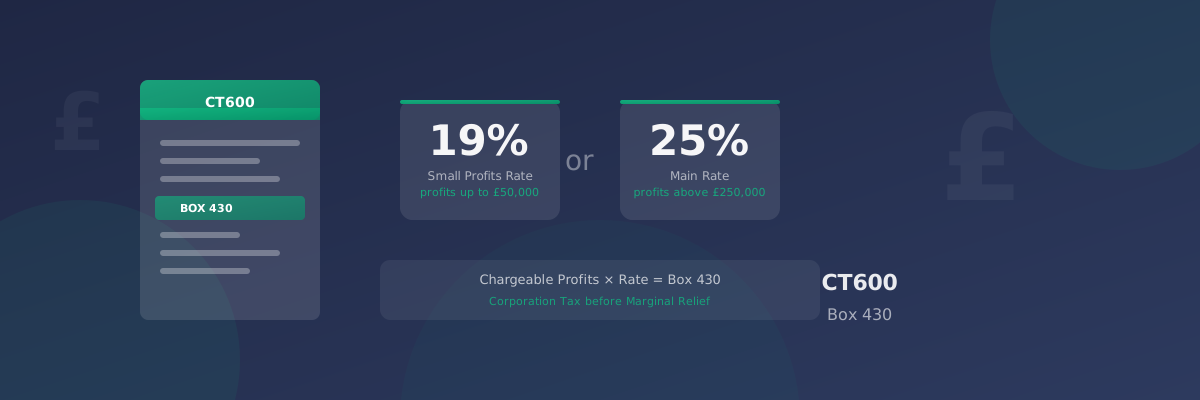
Box 430 contains the corporation tax charged at the applicable rate for your company's accounting period. For periods beginning on or after 1 April 2023, the UK operates a two-rate corporation tax system:
- Small profits rate: 19% — applies when augmented profits are £50,000 or less
- Main rate: 25% — applies when augmented profits are £250,000 or more
> Source: HMRC Corporation Tax rates — GOV.UK
How Box 430 Is Calculated
Box 430 is calculated using your chargeable profits and the applicable rate. It represents the gross tax before any relief — the starting point for your tax computation.
At the Small Profits Rate (19%)
If your company's augmented profits are £50,000 or less, HMRC applies the 19% small profits rate:
``` Box 430 = Chargeable profits x 19% ```
Example: A company with £35,000 in chargeable profits shows £6,650 in Box 430.
At the Main Rate (25%)
If your company's augmented profits exceed £250,000, the main rate of 25% applies:
``` Box 430 = Chargeable profits x 25% ```
Example: A company with £400,000 in chargeable profits shows £100,000 in Box 430.
In the Marginal Relief Band
If augmented profits fall between £50,000 and £250,000, Box 430 still shows the gross tax computed before deducting any marginal relief. The marginal relief amount then appears in CT600 Box 435, and your net tax payable appears in CT600 Box 440:
``` Box 440 = Box 430 - Box 435 ```
This separation gives HMRC a clear audit trail showing the gross tax liability and the relief applied separately.
What Are Augmented Profits?
The rate band that applies to Box 430 depends on your augmented profits, not just your trading profits. Augmented profits include your chargeable profits plus any franked investment income (dividends received from other UK companies). For most small owner-managed companies with no investment income, augmented profits equal chargeable profits.
Augmented profits are also used to determine whether associated company threshold reductions apply — see the next section.
Associated Companies and Rate Thresholds
One area that often surprises directors is the effect of associated companies. If your company has associated companies — broadly, companies under common control — the £50,000 and £250,000 thresholds are divided by the total number of associated companies (including your own).
| Number of companies | Small profits threshold | Main rate threshold |
|---|---|---|
| 1 (no associates) | £50,000 | £250,000 |
| 2 | £25,000 | £125,000 |
| 3 | £16,667 | £83,333 |
| 4 | £12,500 | £62,500 |
The number of associated companies is reported in CT600 Box 420. For a full explanation of how associated companies are counted and how they affect your rate band, see our guide to associated companies and corporation tax.
Accounting Periods Spanning Financial Years
If your accounting period straddles 1 April — for example, running from 1 January 2023 to 31 December 2023 — Box 430 reflects a blended calculation. Profits are time-apportioned across two financial years: FY2022 (before 1 April 2023, at the flat 19% rate) and FY2023 (from 1 April 2023, where rates depend on profit level).
The CT600 has separate boxes for the rates applied in each financial year. Box 430 then reflects the combined tax across both portions of the period.
For accounting periods entirely before 1 April 2023, the single 19% flat rate applied to all companies regardless of profit level, so Box 430 simply equalled chargeable profits multiplied by 19%.
Box 430 for Different Company Types
Most UK limited companies — whether trading or holding — use the standard rate structure above. A few exceptions exist:
- Unit trusts and OEICs — taxed at a flat 20% rate regardless of profit level
- Ring fence profits — companies with North Sea oil and gas profits use separate ring fence corporation tax rates, reported through CT600 Box 405
- Dormant companies — with no taxable profits, Box 430 will be nil (though a CT600 must still be filed each year)
How Box 430 Fits Into the Tax Computation
Box 430 sits within a sequence of calculations in the CT600 that builds up to your final tax liability:
| Box | Description |
|---|---|
| Box 315 | Chargeable profits (income and gains after deductions) |
| Box 420 | Number of associated companies |
| Box 430 | Corporation tax at the applicable rate (before relief) |
| Box 435 | Marginal Relief deduction (if applicable) |
| Box 440 | Corporation tax payable (Box 430 minus Box 435) |
Common Questions About Box 430
My Box 430 is zero — is that correct?
Yes. If your company has zero or negative chargeable profits, Box 430 will be nil. Loss-making companies and dormant companies commonly show a zero Box 430. You may still need to file a CT600, but no tax will be due.
Box 430 seems higher than I expected — why?
Check your number of associated companies (Box 420). If the thresholds have been reduced, you may be in the main rate (25%) band even with relatively modest profits. Also check whether any franked investment income has increased your augmented profits above the small profits threshold.
Is Box 430 the same as the tax I need to pay?
Not necessarily. Box 430 is the gross tax before marginal relief. Your actual payment is shown in Box 440 (after deducting any marginal relief from Box 435). Box 430 also does not reflect any research and development tax credits or other reliefs that appear later in the computation.
When did the two-rate system begin?
The current two-rate system — 19% small profits rate and 25% main rate — came into effect for accounting periods beginning on or after 1 April 2023. Before that date, a single 19% rate applied to all companies. For a full history of rates, see our guide to corporation tax rates.
What if my profits are exactly at a threshold?
If augmented profits are exactly £50,000, the small profits rate (19%) applies and Box 435 is nil. If augmented profits are exactly £250,000, the main rate (25%) applies and Box 435 is also nil. Marginal relief only applies strictly between the two thresholds.
Worked Examples
Example 1: Small company, profits well below threshold
A sole-director consultancy with £28,000 chargeable profits and no associated companies:
- Augmented profits: £28,000 (below £50,000)
- Rate: 19%
- Box 430: £5,320
- Box 435: £0 (no marginal relief needed)
- Box 440: £5,320
Example 2: Larger company, main rate applies
A trading company with £320,000 chargeable profits and no associated companies:
- Augmented profits: £320,000 (above £250,000)
- Rate: 25%
- Box 430: £80,000
- Box 435: £0 (no marginal relief)
- Box 440: £80,000
Example 3: Marginal band
A company with £120,000 chargeable profits and no associated companies:
- Augmented profits: £120,000 (within marginal band)
- Gross rate: 25%
- Box 430: £30,000
- Box 435: £3,900 (marginal relief reduces tax)
- Box 440: £26,100 (effective rate approximately 21.75%)
Summary
CT600 Box 430 is your gross corporation tax charge — the tax your company owes before any marginal relief is applied. It is calculated at either 19% (small profits rate) or 25% (main rate), depending on your augmented profits and the number of associated companies you have. If marginal relief applies, it appears in Box 435 and is deducted to give the final tax payable in Box 440. Checking Box 430 alongside Boxes 435 and 440 gives you a complete picture of how your corporation tax bill is built up.