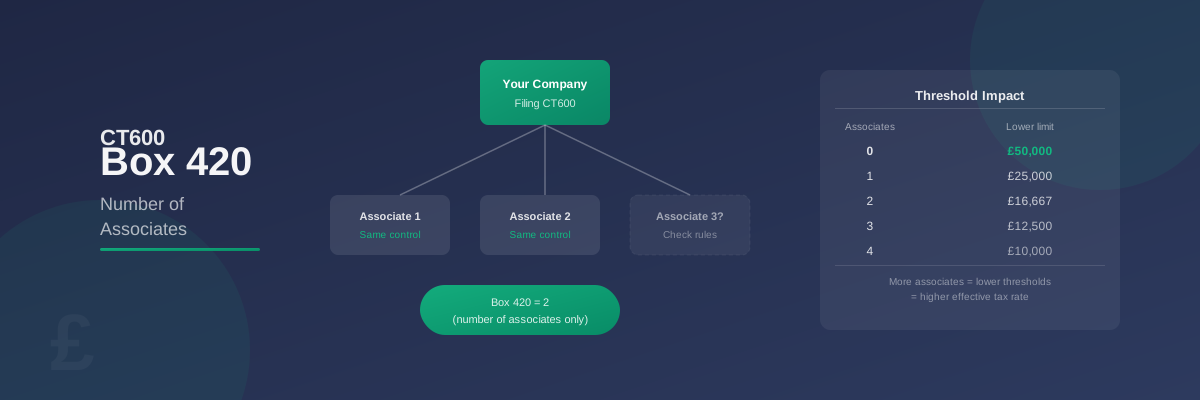
CT600 Box 420: Number of Associates Explained
CT600 Box 420 asks for the number of associated companies your company has during the accounting period. This is one of the most impactful — yet most overlooked — boxes on the company tax return. Getting it wrong can mean paying the wrong rate of corporation tax or miscalculating your marginal relief.
Why Box 420 Matters
Since April 2023, UK corporation tax operates on a three-rate system:
- Small profits rate: 19% on profits up to £50,000
- Marginal relief band: tapered rate for profits between £50,000 and £250,000
- Main rate: 25% on profits over £250,000
For the full breakdown of rates and thresholds, see our UK Corporation Tax Rates guide.
What Is an Associated Company?
An associated company is a company that is related to yours through common control. Two companies are associated if one controls the other, or if both are controlled by the same person or group of persons.
Control typically means owning more than 50% of the ordinary share capital or voting rights. Common scenarios include:
- A director running multiple companies: If you own and control two separate limited companies, they are associated with each other
- Family-owned companies: Companies controlled by connected persons — spouse, parent, civil partner, sibling — may be treated as associated depending on the degree of involvement
- Holding companies and subsidiaries: A parent company and its wholly-owned subsidiaries are associated companies
- Dormant companies: A dormant company still counts as associated if it is under common control — dormancy alone does not remove the association
How the Threshold Division Works
The lower (£50,000) and upper (£250,000) thresholds are divided by the total number of companies in the group — which means your company plus all associates.
The formula is straightforward:
> Adjusted threshold = Standard threshold ÷ (1 + number of associates)
Here is how this plays out in practice:
| Associates | Total companies | Lower threshold | Upper threshold |
|---|---|---|---|
| 0 | 1 | £50,000 | £250,000 |
| 1 | 2 | £25,000 | £125,000 |
| 2 | 3 | £16,667 | £83,333 |
| 3 | 4 | £12,500 | £62,500 |
| 4 | 5 | £10,000 | £50,000 |
What to Enter in Box 420
Enter the number of associates only — not the total number of companies, and not including your own company.
- If you run two companies and they are associated: Box 420 = 1
- If you run four associated companies: Box 420 = 3
- If you run only one company with no associated companies: Box 420 = 0
Timing: The figure should represent the position during the accounting period. If a company became associated or ceased to be associated during the period, the rules are more nuanced. In general, HMRC looks at whether companies were associated at the beginning of the accounting period, but if significant changes occurred mid-year, professional advice is recommended.
When Box 420 Is Zero
The majority of small companies filing a CT600 will enter 0 in Box 420. This is appropriate if:
- You own a single limited company
- Your company has no subsidiaries
- No other company shares control with yours
- No connected persons control other companies
The Impact on Marginal Relief
Marginal relief smooths the transition between the 19% small profits rate and the 25% main rate for companies with profits in the band between the lower and upper thresholds. But if you have associates, those thresholds fall — which can mean:
- A company that would previously have qualified for the small profits rate now sits in the marginal relief band
- A company that would have been in the marginal relief band now pays the full main rate
- A higher effective tax rate on the same profit level
However, ABC has one associated company. The lower threshold falls to £25,000. Now, with profits of £40,000, ABC falls within the marginal relief band. Its effective rate will be somewhere between 19% and 25% — higher than it would pay without the associate.
For a full explanation of how marginal relief is calculated, see our Marginal Relief for Corporation Tax guide.
Box 420 and Short Accounting Periods
Both thresholds are also reduced for accounting periods shorter than 12 months. If your period is, say, 9 months, the thresholds are multiplied by 9/12.
When combined with the associated company reduction, a short-period company with associates can find its lower threshold reduced significantly:
> Lower threshold = £50,000 × (days in period ÷ 365) ÷ (1 + associates)
Filing software handles this calculation automatically. If you are filing manually or checking figures, always apply both adjustments — not just one.
How TinyTax Handles Box 420
In TinyTax, you are asked how many associated companies you have as part of the filing setup. Once entered:
- The adjusted thresholds are calculated automatically
- The correct corporation tax rate is applied to your profits
- Marginal relief (if applicable) is calculated on the adjusted lower and upper limits
- Box 420 on the CT600 is populated with the figure you provided
Common Questions About Box 420
Does a dormant company count as an associate? Yes. A dormant company under common control still counts as an associated company for Box 420 purposes. This catches many directors off guard — a dormant holding company or a second company registered but not yet trading is still relevant.
My spouse owns a separate company. Does that count? Possibly. The rules on connected persons include spouses and civil partners. Whether the companies are treated as associated depends on whether the connected persons are acting together in relation to both companies. HMRC guidance on "substantial commercial interdependence" is relevant here — if the companies share customers, premises, staff, or finance, they are more likely to be associated.
What about overseas companies? Overseas companies can count as associates if they meet the control criteria. The rules apply regardless of where the associated company is resident.
What if the number of associates changed during the year? As a general rule, the position at the start of the accounting period is used. However, if there were significant changes — for example, a new subsidiary was incorporated, or you disposed of shares in a connected company — the rules can require a more nuanced approach. Seek advice if your situation is not straightforward.
Does Box 420 affect any boxes other than the tax rate? Box 420 directly feeds into the marginal relief calculation and can also affect instalment payment obligations (very large companies must pay tax in instalments, and associated companies are counted when assessing whether a company qualifies as "large"). For most small companies, the tax rate impact is the primary concern.
Related: Box 410 and the Total Profits Calculation
Once Box 420 is established and the correct thresholds are applied, corporation tax is calculated on the profits shown in CT600 Box 410 (Total Profits). The connection between Box 410 (what you earned) and Box 420 (how many companies share your thresholds) is central to arriving at the right tax liability.
Summary
CT600 Box 420 records the number of associated companies your business has, and it has a direct, material impact on your corporation tax rate. More associates mean lower thresholds, which means higher effective tax on the same profit level. Most single-company owner-directors will enter 0. If you do have associated companies — including dormant ones — enter the correct count to ensure your marginal relief calculation and overall tax liability are accurate. Remember: enter the number of associates only, not the total including your own company.