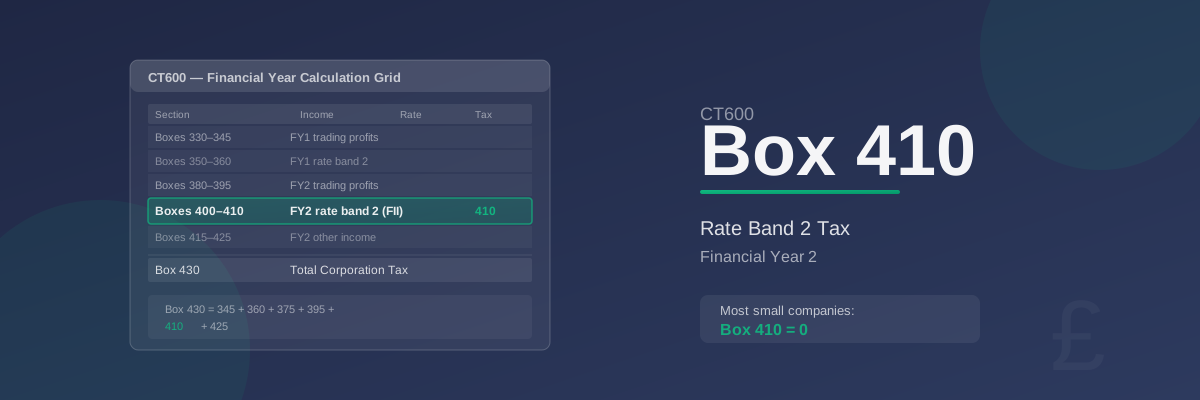
CT600 Box 410: Total Profits and the Financial Year Calculation Grid
CT600 Box 410 appears in the financial year calculation table on your company tax return. It records the corporation tax calculated on rate band 2 income falling within the second financial year of your accounting period. For the vast majority of small and medium-sized companies, this box will be zero — but understanding what it represents helps you verify that your CT600 has been completed correctly.
Where Does Box 410 Sit on the CT600?
Box 410 is part of the financial year calculation grid in Section 11 of the CT600. This grid exists because UK financial years run from 1 April to 31 March, and your company's accounting period may straddle two of them. When that happens, HMRC needs to know how much income falls into each financial year so the correct corporation tax rate can be applied to each portion.
The grid has two main sections: one for the first financial year (FY1) and one for the second financial year (FY2). Within each section, different types of income are broken out into separate rows — known as rate bands.
| Box Range | Description |
|---|---|
| Boxes 330–345 | FY1: Main trading profits |
| Boxes 350–360 | FY1: Rate band 2 income |
| Boxes 365–375 | FY1: Rate band 3 income |
| Boxes 380–395 | FY2: Main trading profits |
| Boxes 400–410 | FY2: Rate band 2 income |
| Boxes 415–425 | FY2: Rate band 3 (other income) |
| Box 430 | Total corporation tax |
What Is Rate Band 2?
Rate band 2 in the CT600 typically covers franked investment income (FII) — dividends received from other UK companies on which corporation tax has already been paid. In some circumstances it can also relate to ring fence profits (for oil and gas companies), though this is far less common.
For most small and micro-entity companies:
- You do not receive dividends from other UK companies that qualify as FII
- Your company does not extract oil or gas on the UK Continental Shelf
- Box 410 will therefore be zero
How Box 410 Is Calculated
Within the FY2 rate band 2 row, there are three boxes:
| Box | Description |
|---|---|
| Box 400 | Amount of rate band 2 income (e.g. FII) |
| Box 405 | Rate of corporation tax applicable to that income |
| Box 410 | Tax calculated: Box 400 × Box 405 rate |
If your company has no franked investment income or ring fence profits, Box 400 will be zero, Box 405 will be blank, and Box 410 will be zero.
Worked Example
Suppose a company's accounting period runs from 1 January to 31 December, straddling two financial years. The company received franked investment income of £20,000 during the part of its accounting period that falls in FY2.
| Box | Value |
|---|---|
| Box 400 (FII in FY2) | £20,000 |
| Box 405 (tax rate) | 25% |
| Box 410 (tax on FII) | £5,000 |
In practice, most small company tax returns are processed entirely by software, and Box 410 is populated automatically based on the figures you enter elsewhere.
How Box 410 Relates to Box 430
Box 430 (Corporation Tax) represents the total tax calculated on all categories of income across both financial years. It is derived by summing the tax from each rate band row:
Box 430 = Box 345 + Box 360 + Box 375 + Box 395 + Box 410 + Box 425
| Tax Component | Box |
|---|---|
| FY1 main rate tax | Box 345 |
| FY1 rate band 2 tax | Box 360 |
| FY1 rate band 3 tax | Box 375 |
| FY2 main rate tax | Box 395 |
| FY2 rate band 2 tax | Box 410 |
| FY2 rate band 3 tax | Box 425 |
| Total | Box 430 |
When Does Box 410 Have a Non-Zero Value?
Box 410 will only contain a figure if all three of the following are true:
- Your accounting period spans two UK financial years — meaning it starts before 1 April and ends after 31 March, or vice versa
- Your company has rate band 2 income — specifically franked investment income from UK company dividends that are chargeable to corporation tax, or ring fence profits
- Some or all of that income falls in the second financial year — meaning the income is apportioned to the FY2 portion of your accounting period
Most Companies Can Ignore Box 410
The rate band 2 section of the CT600 is primarily relevant to:
- Large companies that hold shares in other UK companies and receive dividends subject to corporation tax
- Holding companies within a group structure, where inter-company dividends may qualify as FII
- Oil and gas companies with ring fence profits
Box 410 and Total Profits
It is worth clarifying the relationship between Box 410 and the concept of total profits on the CT600.
The company's total chargeable profits — the overall figure on which corporation tax is calculated — appears in Box 315 of the CT600. This is the starting point for the entire tax calculation.
The financial year calculation grid (where Box 410 sits) takes those profits and breaks them down by financial year and income type. Box 410 is not a profits figure — it is the tax calculated on a specific subset of profits. The grid exists to apply the correct tax rate to each category of income, accounting for the fact that rates may differ between financial years or income types.
Understanding this distinction makes it easier to review your CT600 and check that the figures in the tax calculation section are consistent with the profit figures earlier in the form.
Checklist: Box 410 on Your CT600
When reviewing your CT600, check the following:
- Does your accounting period straddle two UK financial years? If not, Box 410 is not applicable.
- Does your company have franked investment income or ring fence profits? If not, Box 410 should be zero.
- If Box 400 has a value, does Box 410 correctly reflect the tax on that amount at the Box 405 rate?
- Does Box 430 equal the sum of Boxes 345, 360, 375, 395, 410, and 425?
Related Boxes
For a complete picture of how Box 410 fits into the broader tax calculation, see:
- CT600 Box 400: Franked Investment Income Explained — what goes into rate band 2 income
- CT600 Box 440: Corporation Tax Payable — where the calculation leads
- CT600 Boxes Explained: Complete Guide — overview of all CT600 boxes
Summary
CT600 Box 410 records the corporation tax calculated on rate band 2 income (primarily franked investment income) falling within the second financial year of your accounting period. For most small companies, this box is zero because they do not have franked investment income or ring fence profits. Where it does apply, Box 410 contributes to Box 430 (total corporation tax), which in turn feeds into the final corporation tax payable figure in Box 440.