CT600 Box 435: Marginal Relief for Corporation Tax
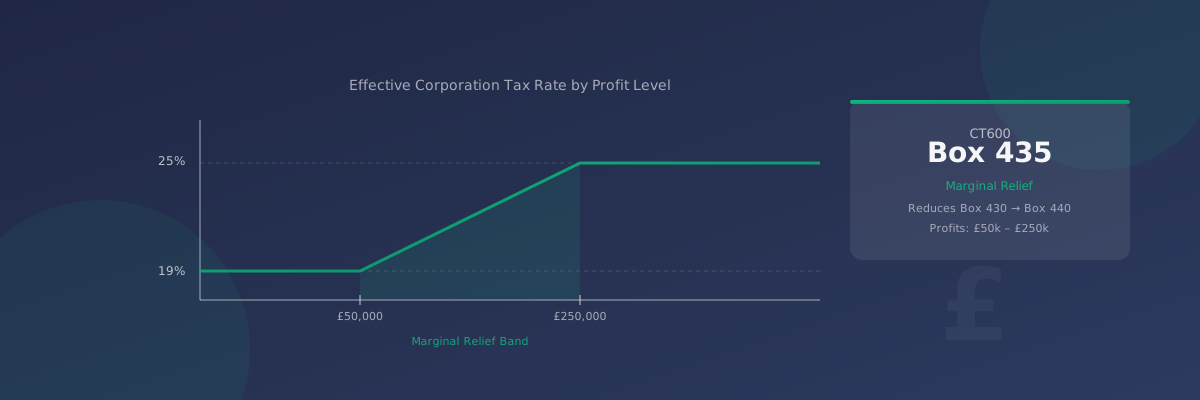
CT600 Box 435 shows the marginal relief deduction — a reduction in your corporation tax bill available to companies whose augmented profits fall between £50,000 and £250,000. Understanding Box 435 helps you see how the two-rate corporation tax system works in practice and how relief is applied to ease the transition between the small profits rate and the main rate.
What Is CT600 Box 435?
Box 435 contains the amount of marginal relief your company can deduct from its gross corporation tax charge. The gross tax — calculated at the applicable rate — appears in CT600 Box 430. Box 435 is then subtracted to produce the final net corporation tax payable in CT600 Box 440:
``` Box 440 (Net CT) = Box 430 (Gross CT) - Box 435 (Marginal Relief) ```
Without marginal relief, a company with profits of £100,000 would pay the full 25% main rate (£25,000 in tax), even though a company with profits of £50,000 pays only 19% (£9,500). Marginal relief smooths out this cliff edge by gradually increasing the effective tax rate as profits rise from £50,000 towards £250,000.
> Source: HMRC Corporation Tax rates — GOV.UK
Who Qualifies for Marginal Relief?
Marginal relief applies when your company's augmented profits fall strictly between the lower and upper limits for the relevant financial year:
| Scenario | Lower limit | Upper limit |
|---|---|---|
| 1 company (no associates) | £50,000 | £250,000 |
| 2 companies (1 associate) | £25,000 | £125,000 |
| 3 companies (2 associates) | £16,667 | £83,333 |
| 4 companies (3 associates) | £12,500 | £62,500 |
If your profits are below the lower limit, Box 435 is nil (you pay only the 19% small profits rate — no relief is needed). If your profits are above the upper limit, Box 435 is also nil (you pay the full 25% main rate on all profits).
The number of associated companies is reported in CT600 Box 420. For a detailed explanation of how associated companies affect your thresholds, see our guide to associated companies and corporation tax.
How Marginal Relief Is Calculated
HMRC uses a standard marginal relief fraction formula. The relief amount is calculated as:
``` Marginal Relief = (U - A) x (N / A) x 3/200 ```
Where:
- U = upper threshold (£250,000, divided by the number of associated companies)
- A = augmented profits (chargeable profits plus any franked investment income)
- N = chargeable profits
- 3/200 = the marginal relief fraction for financial years from April 2023
``` Marginal Relief = (U - A) x 3/200 ```
In practice, most directors do not calculate this manually. Filing software calculates the figure automatically and populates Box 435 accordingly.
A Worked Example
A company with £100,000 chargeable profits, no associated companies, and no franked investment income:
- Gross tax at 25% (Box 430): £100,000 x 25% = £25,000
- Marginal relief (Box 435):
- Net tax payable (Box 440): £25,000 - £2,250 = £22,750
Effective Tax Rates Across the Marginal Band
Marginal relief ensures the effective rate increases gradually rather than jumping from 19% to 25% at the £50,000 threshold. Here is how the effective rate changes across the band for a single company with no associates:
| Augmented profits | Gross tax (25%) | Marginal relief | Net tax | Effective rate |
|---|---|---|---|---|
| £50,000 | £9,500 (at 19%) | £0 | £9,500 | 19.0% |
| £75,000 | £18,750 | £2,812 | £15,938 | 21.25% |
| £100,000 | £25,000 | £2,250 | £22,750 | 22.75% |
| £150,000 | £37,500 | £1,500 | £36,000 | 24.0% |
| £200,000 | £50,000 | £750 | £49,250 | 24.625% |
| £250,000 | £62,500 | £0 | £62,500 | 25.0% |
Periods Spanning Financial Years
If your accounting period straddles 1 April, the marginal relief calculation is applied proportionally to the profits attributed to the financial year from April 2023 onwards. The pre-April 2023 portion uses the flat 19% rate, where marginal relief did not exist.
For accounting periods entirely before 1 April 2023, Box 435 will always be nil — the single 19% rate applied to all companies and there was no marginal relief regime.
What About Franked Investment Income?
Franked investment income (dividends received from other UK companies) is included in augmented profits but not in chargeable profits. This affects the N/A ratio in the marginal relief formula, reducing the relief available.
Example: A company with £80,000 chargeable profits and £30,000 franked investment income:
- Augmented profits (A): £110,000
- Chargeable profits (N): £80,000
- N/A ratio: 80,000 / 110,000 = 0.727
- Marginal relief: (£250,000 - £110,000) x 0.727 x 3/200 = £1,527 (compared to £2,100 without the investment income)
How Box 435 Fits Into the Tax Computation
| Box | Description |
|---|---|
| Box 315 | Chargeable profits |
| Box 420 | Number of associated companies |
| Box 430 | Corporation tax at applicable rate (before relief) |
| Box 435 | Marginal Relief deduction |
| Box 440 | Net corporation tax payable (Box 430 minus Box 435) |
Common Questions About Box 435
My Box 435 is zero — does that mean I am not getting any relief?
Not necessarily. If your profits are below £50,000 (adjusted for associates), you already pay only 19% — no relief is needed, and Box 435 is correctly nil. If your profits exceed £250,000, you pay the full 25% and Box 435 is also nil. Marginal relief only reduces tax for companies in the band between these two figures.
Should I verify the Box 435 figure myself?
It is worth understanding the calculation if your profits are close to the threshold boundaries, particularly if your company has associated companies. A miscounted associated company can shift your thresholds significantly and move you into a different rate band. Review Box 420 to confirm associated companies are reported correctly.
When was marginal relief reintroduced?
Marginal relief was reintroduced from 1 April 2023, when the main corporation tax rate rose from 19% to 25%. It had previously existed before April 2015, when all companies paid a single 19% rate and no marginal relief was needed. See our guide to corporation tax rates for the full rate history.
Does marginal relief affect instalment payments?
Large companies making quarterly instalment payments base these on their expected net tax liability (Box 440 after relief). However, the threshold for instalment payments is annual profits exceeding £1.5 million — well above the marginal relief band — so this interaction rarely arises in practice.
What if I have a short accounting period?
For short accounting periods (less than 12 months), both the lower and upper thresholds are reduced proportionally. A nine-month accounting period, for example, uses thresholds of £37,500 and £187,500 rather than £50,000 and £250,000. This means more short-period companies fall into the marginal band than would if their period ran for a full year.
Summary
CT600 Box 435 shows the marginal relief deduction for companies with augmented profits between £50,000 and £250,000 (adjusted proportionally for associated companies and short periods). It reduces the gross corporation tax in Box 430 to give the final net tax payable in Box 440. If your profits are below the lower threshold or above the upper threshold, Box 435 will be nil — you are already paying at the appropriate fixed rate and no relief is needed. Understanding Box 435 alongside Boxes 430 and 440 gives you a complete picture of how your corporation tax liability is calculated under the two-rate system.