Limited Company Tax: Everything Directors Need to Know
Running a limited company means dealing with several different taxes. Understanding what taxes your company owes—and when—helps you plan your finances and stay compliant with HMRC.
What Taxes Does a Limited Company Pay?
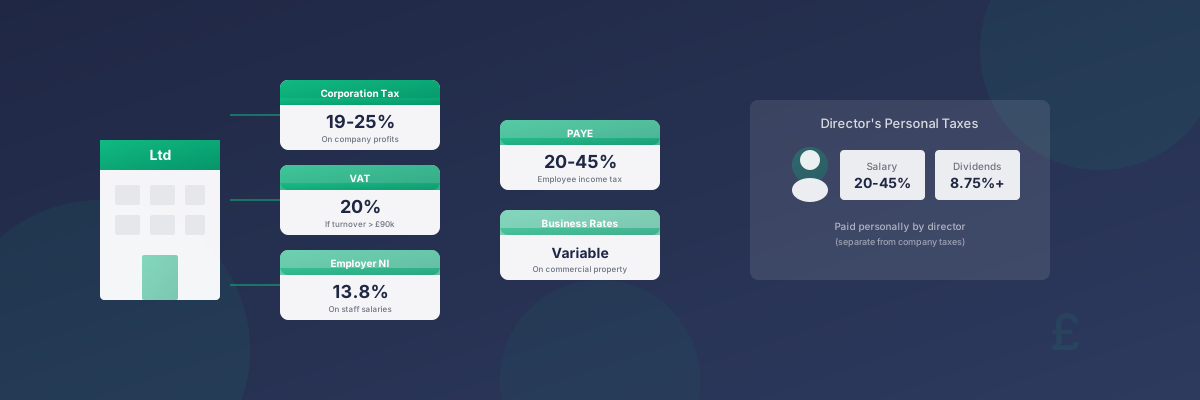
Your limited company may need to pay several types of tax:
| Tax | What It's On | Who Pays |
|---|---|---|
| Corporation tax | Company profits | The company |
| VAT | Sales (if registered) | The company (collected from customers) |
| Employer's NI | Staff salaries | The company |
| PAYE | Employee wages | Collected by company, paid to HMRC |
| Business rates | Commercial property | The company |
Corporation Tax
Corporation tax is the main tax your limited company pays on its profits.
Current Rates (2023/24 onwards)
| Profit Level | Tax Rate |
|---|---|
| Up to £50,000 | 19% (small profits rate) |
| Over £250,000 | 25% (main rate) |
| £50,001 to £250,000 | 19-25% (marginal relief applies) |
Key Deadlines
- Payment: 9 months and 1 day after your accounting period ends
- Filing: 12 months after your accounting period ends
- Pay by 1 January 2026
- File by 31 March 2026
VAT (Value Added Tax)
VAT is a tax on sales. If your company is VAT-registered, you:
- Charge VAT on your sales
- Reclaim VAT on business purchases
- Pay the difference to HMRC (or claim a refund)
Do You Need to Register?
Mandatory registration: If your taxable turnover exceeds £90,000 in any 12-month period, you must register for VAT.
Voluntary registration: You can register even if below the threshold. This lets you reclaim VAT on purchases, which can be beneficial if you sell to other businesses.
VAT Rates
| Rate | Amount | Applies To |
|---|---|---|
| Standard | 20% | Most goods and services |
| Reduced | 5% | Some goods (e.g., home energy) |
| Zero | 0% | Some goods (e.g., children's clothes, most food) |
Filing VAT Returns
VAT returns are usually filed quarterly, though you can opt for monthly or annual schemes.
PAYE and National Insurance
If your company employs anyone (including you as a director), you'll need to run payroll and deal with PAYE.
What You Deduct and Pay
| Tax | Who Pays | Rate |
|---|---|---|
| Employee income tax | Deducted from salary | Based on tax code |
| Employee NI | Deducted from salary | 8% on earnings over £12,570 |
| Employer NI | Company pays | 13.8% on earnings over £9,100 |
Employer's National Insurance
This is a cost to your company on top of salaries. At 13.8%, it adds significantly to employment costs.
Example: If you pay an employee £30,000 salary, employer's NI is approximately £2,884.
Payroll Filing
- Run payroll each pay period
- Submit Full Payment Submission (FPS) to HMRC on or before payday
- Pay HMRC monthly (or quarterly if small employer)
Director's Personal Taxes
As a director, you personally pay tax on money you take from the company:
Salary
Taxed through PAYE like any employee. The first £12,570 is tax-free (personal allowance), then you pay:
- 20% on £12,571 to £50,270
- 40% on £50,271 to £125,140
- 45% on over £125,140
Dividends
If you take dividends from company profits:
- First £500 is tax-free (dividend allowance)
- 8.75% on basic rate band
- 33.75% on higher rate band
- 39.35% on additional rate band
Most Tax-Efficient Strategy
Many director-shareholders pay themselves:
- A small salary (around £12,570 or the NI threshold)
- Dividends for additional income
Business Rates
If your company occupies commercial premises (office, shop, warehouse), you'll pay business rates to your local council.
Small Business Rate Relief
You may qualify for relief if:
- Your property's rateable value is below £15,000
- It's your only business property
Tax Planning for Limited Companies
Allowable Expenses
Reduce your corporation tax by claiming all legitimate business expenses:
- Staff costs
- Office rent and utilities
- Professional services
- Travel and subsistence
- Marketing and advertising
- Equipment and software
Capital Allowances
When buying business assets, claim capital allowances:
- Annual Investment Allowance: 100% deduction on up to £1 million of qualifying assets
- Writing Down Allowance: 18% or 6% for assets not covered by AIA
R&D Tax Credits
If your company does qualifying research and development, you may be able to claim R&D tax credits, reducing your corporation tax bill.
Filing Requirements Summary
| Return | Deadline | Filed With |
|---|---|---|
| Company tax return (CT600) | 12 months after year end | HMRC |
| Annual accounts | 9 months after year end | Companies House |
| Confirmation statement | Annual | Companies House |
| VAT returns | Quarterly (usually) | HMRC |
| PAYE submissions | Each pay day | HMRC |
Common Mistakes to Avoid
- Missing deadlines: Late filing penalties add up quickly
- Mixing personal and business: Keep company money separate
- Not claiming expenses: Many directors miss legitimate deductions
- Forgetting employer NI: Budget for this on top of salaries
- Ignoring VAT threshold: Monitor turnover if approaching £90,000
Get Help with Your Company Tax Return
Filing your company tax return doesn't need to be complicated. TinyTax helps micro companies file their CT600 affordably.
File your company tax return with TinyTax →
Related Guides
- Corporation Tax Explained
- Company Tax Rate UK
- Company Tax Return: Complete Guide
- How to Pay Corporation Tax