Is CT600 Software Free?
If you're looking for free software to file your company's corporation tax return, you're in luck — free CT600 software does exist, and it handles the most common scenarios for small UK limited companies. This guide explains what free tools typically cover, where they fall short, and how to choose the right option for your situation.
What Is CT600 Software?
When you file a company tax return with HMRC, two things are required: a completed CT600 form and a set of iXBRL-tagged company accounts. Both must be submitted together in a specific digital format. Dedicated software handles both tasks — it takes your financial figures, performs the tax calculations, generates the iXBRL accounts, and submits everything directly to HMRC.
Without CT600 software (or an accountant who uses it), it is not possible to submit a company tax return. Paper submissions are not accepted by HMRC.
For an overview of the filing process, see How to File Your Company Tax Return.
Yes — Free CT600 Software Is Available
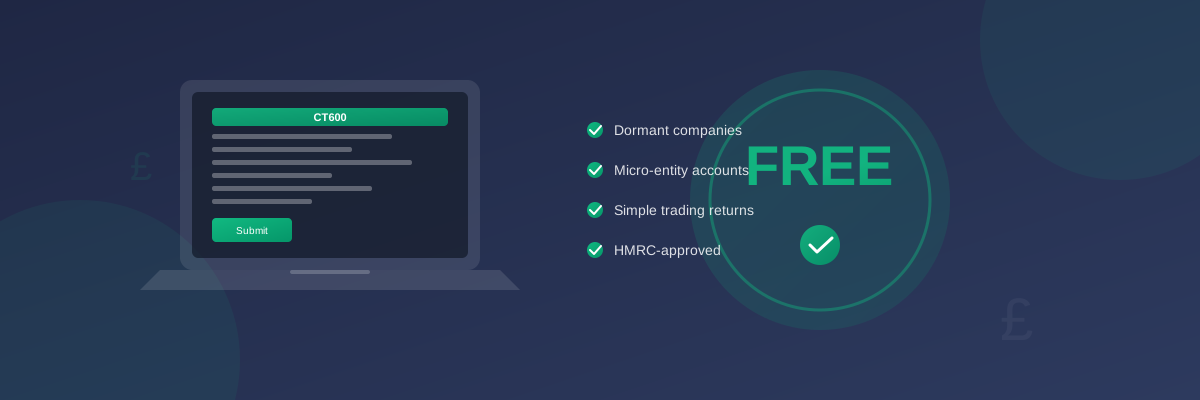
Several HMRC-approved providers offer free CT600 software for common filing scenarios. Free options typically cover:
- Dormant companies — returns where the company had no trading activity during the period
- Micro-entity companies — small companies filing simplified accounts below certain size thresholds
- Simple trading companies — owner-managed companies with straightforward income and standard allowable expenses
What About HMRC's Own Service?
HMRC previously operated a free online filing service that allowed qualifying companies to submit their CT600 directly through GOV.UK. That service is being withdrawn. Companies that have used it in the past will need to switch to HMRC-approved third-party software going forward.
For more detail, read HMRC CT600 Service Closing — What You Need to Know and What Replaces HMRC's Free Filing Service?.
What Do Free Tools Cover?
Free CT600 software generally handles the most common filing scenarios well. The table below gives a rough guide to what is typically included:
| Scenario | Typically free? |
|---|---|
| Dormant company return | Yes |
| Micro-entity accounts + CT600 | Yes |
| Simple trading company (standard income and expenses) | Yes |
| Capital allowances (AIA, standard writing-down) | Sometimes |
| Directors' loan accounts | Sometimes |
| Marginal relief calculation | Sometimes |
| R&D tax credit claims | Rarely |
| Extended or split accounting periods | Rarely |
| Multiple associated companies | Rarely |
Where Free Software Has Limits
Free tools generally draw the line at more complex scenarios:
Capital allowances
Claiming Annual Investment Allowance (AIA) on equipment, vehicles, or machinery, or computing writing-down allowances on longer-life assets, is sometimes restricted in free-tier products. If you have made significant purchases during the year, check whether the free tool supports the allowances you intend to claim. See Capital Allowances on a CT600 for background.
R&D tax credits
Research and development relief requires a separate schedule on the CT600 alongside detailed supporting information. This is rarely available in free-tier tools, and the complexity generally warrants professional software or an accountant.
Extended accounting periods
If your accounting period exceeds 12 months — which happens in a company's first year if the period runs longer than usual — HMRC requires two separate CT600 submissions. Not all free tools support this split-period handling. This is worth checking before you start if your company is newly incorporated.
Associated companies
The corporation tax profit thresholds (£50,000 for the small profits rate, £250,000 for the main rate) are divided equally among all companies that are associated with one another. If you own more than one company, this affects the rate you pay. Handling the association correctly requires entering the number of associates, which some free tools may not fully support. See Associated Companies and Corporation Tax.
iXBRL accounts quality
Free tools may offer fewer options for account formatting or iXBRL tagging depth. If you are filing micro-entity accounts this is unlikely to matter, but companies using small company or full accounts formats may need more flexibility than a free tool provides.
Free vs Paid: A Quick Guide
| Situation | Recommended option |
|---|---|
| Dormant company | Free software |
| Micro-entity, no unusual transactions | Free software |
| Simple trading company | Free software |
| Capital allowances claims | Free or paid (check coverage) |
| R&D credits | Paid software or accountant |
| Extended or split accounting period | Paid software or accountant |
| Multiple associated companies | Paid software |
| Complex or high-value returns | Accountant |
How Much Does Paid CT600 Software Cost?
Paid CT600 software varies considerably in price. Some providers charge per submission, others charge an annual subscription. Professional platforms aimed at accountants managing multiple client returns are priced differently from tools designed for individual directors.
For small companies that need functionality beyond a free tier — such as capital allowances support or extended period handling — the step up to a low-cost paid tool is often modest. For a comparison of current options, see Best CT600 Software for Small Companies.
Can Directors File Their Own CT600?
Yes — there is no legal requirement to use an accountant. Any company director can file the CT600 themselves using HMRC-approved software. The process involves entering your financial figures, reviewing the calculated corporation tax, and submitting to HMRC.
For first-time filers, the First Company Tax Return Guide walks through the process step by step. If you're wondering whether you should do it yourself, read Can I File My CT600 Myself?.
What You Will Need Before You Start
Regardless of whether you use free or paid software, you will typically need:
- Your company's Unique Taxpayer Reference (UTR) — see What Is a UTR Number?
- Your company's registered number
- Your annual accounts, or a trial balance from your accounting software
- Details of any capital allowances you intend to claim
- Details of any losses carried forward from previous years
Summary
Free CT600 software is available and works well for the most common filing scenarios: dormant companies, micro-entities, and straightforward trading returns. If your company has R&D claims, extended accounting periods, or complex capital allowances, you may need paid software or professional help. With HMRC's own free service closing, it is worth identifying a suitable alternative now. Start with our guide to free CT600 options for small companies.