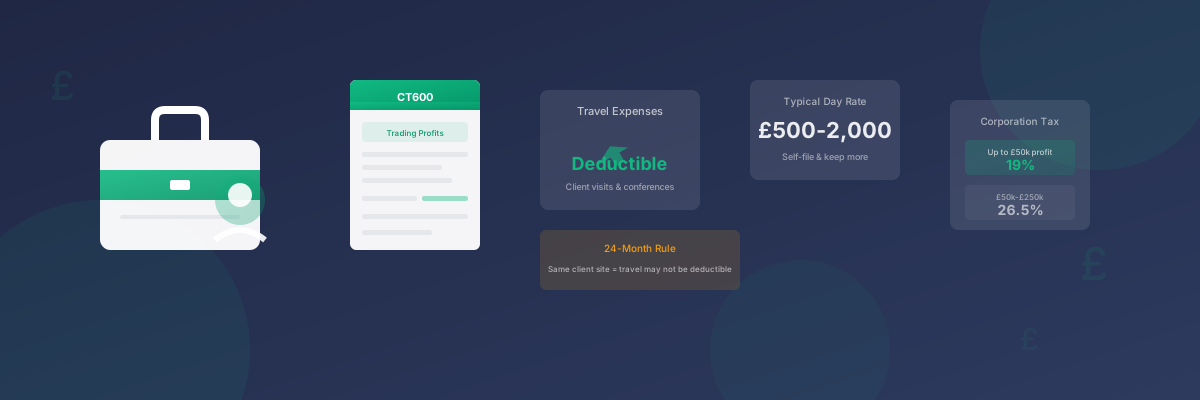
Company Tax Return Guide for Management Consultants
Management consultants running a limited company must file a company tax return with HMRC at the end of each financial year. Whether you advise on strategy, operations, digital transformation, or organisational change, understanding how corporation tax applies to your consultancy income helps you stay compliant and avoid overpaying tax.
What Is a Company Tax Return?
A company tax return — officially called the CT600 — reports your limited company's taxable profits and calculates the corporation tax owed. HMRC requires every active UK limited company to file one, even if no tax is due.
For management consultants, your company tax return will cover:
- Consultancy fees, retainers, and project income received by the company
- Allowable business expenses that reduce your taxable profit
- Capital allowances on equipment and assets
- Any tax reliefs or credits your company is entitled to
- The final corporation tax due
Corporation Tax Rates for Consultants
The corporation tax your consultancy pays depends on its taxable profits:
| Profits | Rate |
|---|---|
| £50,000 or less | 19% (small profits rate) |
| £50,001 – £250,000 | Marginal relief applies |
| Over £250,000 | 25% (main rate) |
For a full breakdown, see corporation tax rates explained and how marginal relief is calculated.
Source: GOV.UK Corporation Tax rates
Allowable Expenses for Management Consultants
Legitimate business expenses reduce your company's taxable profit. The key rule is that expenses must be incurred wholly and exclusively for business purposes.
Travel and Client Meetings
Travel to client sites is central to most management consultancy work:
- Mileage when using a personally-owned vehicle, claimed at HMRC's approved rates
- Rail, air, and taxi fares for business journeys
- Hotel accommodation for overnight stays away from home
- Subsistence (meals) on qualifying overnight business trips
Professional Memberships and Training
Management consultants frequently maintain professional qualifications and invest in development:
- Subscriptions to professional bodies such as the Chartered Management Institute (CMI), Management Consultancies Association (MCA), or Institute of Management Consultants (IMC)
- Training courses and qualifications relevant to your consultancy services
- Business books, industry journals, and market research
- Conference and seminar fees
IT Equipment and Technology
Technology costs are significant for most consultants:
- Laptops, tablets, and monitors — claimed through capital allowances (see below)
- Software licences and subscriptions used for client delivery
- Business proportion of mobile phone costs
- Video conferencing and collaboration tools
Home Office Costs
If you work from home, you can claim a proportion of your household costs — including broadband, heating, electricity, and council tax — based on the number of rooms used for work and the proportion of time spent on business.
Professional and Legal Fees
- Accountancy and bookkeeping fees
- Legal advice on contracts, disputes, or business structuring
- Professional indemnity insurance
- Relevant business insurance premiums
Capital Allowances
When your consultancy buys equipment — a laptop, external screens, or specialist software — you claim capital allowances on these assets rather than simply expensing the full cost.
The Annual Investment Allowance (AIA) allows you to deduct 100% of qualifying plant and machinery costs in the year of purchase. For most management consultants, this means IT equipment and office furniture can be fully offset against profits in the year they are bought.
See our guide to capital allowances on the CT600 for details on how these are reported on your company tax return.
IR35 and Off-Payroll Working
If any of your consultancy contracts fall within the off-payroll working rules (IR35), this has a significant impact on your company tax return.
Where IR35 applies:
- Your client (or the agency in the supply chain) is responsible for determining IR35 status for medium and large businesses
- The fee income from that contract is treated as deemed employment income
- Income tax and National Insurance contributions are deducted before payment reaches your company
- Your company's taxable profits for corporation tax are typically reduced to nil (or a small residual amount) on those contracts
Dividends, Salary, and the Company Tax Return
Most management consultants extract profits through a combination of low salary and dividends. This is legitimate and widely used, but it is important to understand how it interacts with your company tax return:
- Salary is an allowable business expense for the company — it reduces taxable profit before corporation tax is calculated
- Dividends are paid from post-tax profit — they do not reduce the company's corporation tax liability
- Your company pays corporation tax first, then distributes the after-tax profits as dividends
Directors' Loans
If you borrow money from your company — even informally — this creates a director's loan account. If the loan is not repaid within nine months of the end of your accounting period, the company faces an additional tax charge on the outstanding balance. See our guide to directors' loans on the CT600 for full details.
Filing Deadlines
- CT600 filing deadline: 12 months after the end of your accounting period
- Corporation tax payment deadline: 9 months and 1 day after the end of your accounting period
Common Mistakes Management Consultants Make
Claiming personal expenses: Clothing (unless it is a uniform), gym memberships, and commuting costs are not allowable.
Missing the payment deadline: Many consultants focus on the filing deadline and overlook that tax is due three months earlier.
Ignoring IR35 determinations: If a client has issued a Status Determination Statement saying IR35 applies, this cannot be ignored when preparing accounts and the tax return.
Forgetting capital allowances: Consultants who upgraded their home office setup sometimes forget to claim allowances on new equipment.
Not accounting for associated companies: If you own shares in more than one company, the corporation tax thresholds may be reduced, affecting your rate.
Summary
Management consultants operating through a limited company pay corporation tax at either 19% or 25% depending on profits, with marginal relief available between £50,000 and £250,000. Legitimate expenses — travel, professional subscriptions, training, and IT equipment through capital allowances — reduce your taxable profit. IR35 can significantly alter how your company's income is treated, and it must be accounted for correctly on your company tax return.