HMRC Late Payment Interest on Corporation Tax: How to Calculate It
If you pay your corporation tax after the deadline, HMRC charges interest on the overdue amount from the day after payment was due. Unlike late filing penalties, which are fixed charges, late payment interest accrues daily for as long as the debt remains outstanding. This guide explains the current interest rate, how it is calculated, and what you can do to minimise the cost.
The Payment Deadline
Corporation tax is due 9 months and 1 day after the end of your accounting period. This is a separate and earlier deadline to your filing deadline, which falls 12 months after the period end.
| Accounting period end | Payment deadline | Filing deadline |
|---|---|---|
| 31 March 2025 | 1 January 2026 | 31 March 2026 |
| 30 June 2025 | 1 April 2026 | 30 June 2026 |
| 31 December 2025 | 1 October 2026 | 31 December 2026 |
The Current Interest Rate
HMRC's late payment interest rate is tied to the Bank of England base rate. From 6 April 2025, the formula changed from base rate plus 2.5% to base rate plus 4.00%. This change, introduced by HMRC, increased the effective rate on late payments compared with the previous formula.
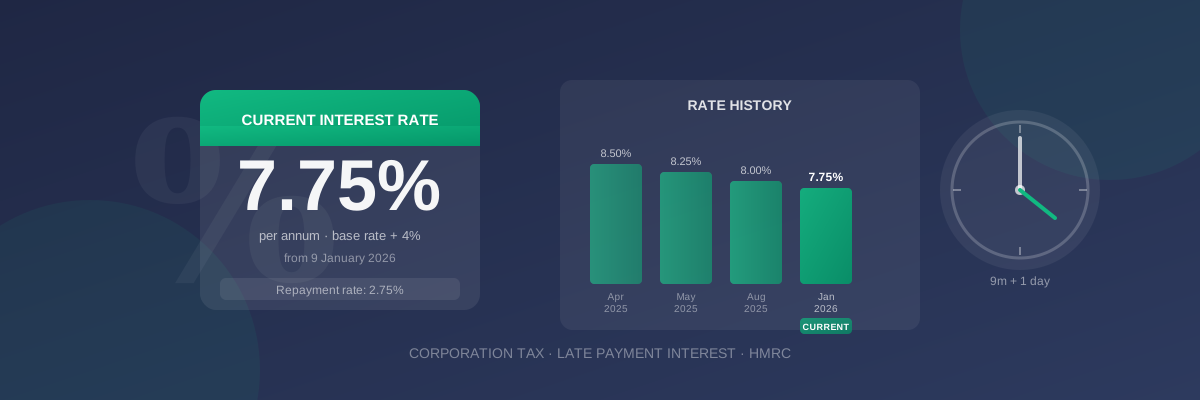
The current late payment interest rate is 7.75% per annum (effective from 9 January 2026), reflecting a Bank of England base rate of 3.75%.
The rate adjusts whenever the Bank of England changes its base rate. HMRC typically updates its rate within a few weeks of a base rate decision.
Recent Rate History
| Effective date | Late payment rate | Repayment rate |
|---|---|---|
| 9 January 2026 | 7.75% | 2.75% |
| 27 August 2025 | 8.00% | 3.00% |
| 28 May 2025 | 8.25% | 3.25% |
| 6 April 2025 | 8.50% | 3.50% |
Always check the GOV.UK page for the current rate before making any calculation, as it changes with base rate decisions.
How to Calculate Late Payment Interest
HMRC applies simple interest only — there is no compounding. Interest does not accrue on top of previously unpaid interest.
Daily interest formula:
``` Daily interest = (Tax owed × Annual rate) ÷ 365 Total interest = Daily interest × Number of days late ```
Worked Example 1: Straightforward Late Payment
Scenario: Your corporation tax bill is £15,000. The payment deadline was 1 January 2026, but you paid on 1 April 2026 — 90 days late. The rate throughout this period was 7.75%.
Calculation:
- Daily interest: (£15,000 × 7.75%) ÷ 365 = £3.18
- Total interest: £3.18 × 90 days = £286.44
Worked Example 2: Partial Payment
Scenario: You owe £30,000. You pay £20,000 on the deadline, leaving £10,000 outstanding for a further 60 days.
Calculation:
- No interest on the £20,000 paid on time
- Interest on the late £10,000: (£10,000 × 7.75%) ÷ 365 × 60 days = £127.40
Worked Example 3: Extended Late Payment
Scenario: You owe £8,000 and pay 180 days (approximately 6 months) late.
Calculation:
- Daily interest: (£8,000 × 7.75%) ÷ 365 = £1.70
- Total interest: £1.70 × 180 days = £305.75
Is Late Payment Interest Tax Deductible?
Yes. Any late payment interest you pay to HMRC is tax deductible for corporation tax purposes. This partially offsets the effective cost, particularly at the higher rates.
Effective cost after tax relief:
| Rate | Tax relief | Effective rate |
|---|---|---|
| Main rate (25%) | 25% of 7.75% = 1.94% | ~5.81% |
| Small profits rate (19%) | 19% of 7.75% = 1.47% | ~6.28% |
Repayment Interest: When HMRC Owes You Money
If you overpay your corporation tax — for example, because you estimated a liability that turned out to be lower — HMRC pays repayment interest on the amount refunded.
The repayment rate is base rate minus 1%, subject to a minimum floor of 0.5%. The current repayment rate is 2.75% (from 9 January 2026).
This rate is deliberately set lower than the late payment rate. The asymmetry reflects HMRC's policy position: the cost of holding HMRC's money is higher than the return you receive if HMRC holds yours.
What Happens If You Do Not Pay
Interest is just the financial cost of late payment. HMRC also has enforcement powers for persistent non-payment:
- Debt collection action — HMRC may instruct debt collectors or pursue county court judgements
- Distraint — seizure of business assets (rare, but possible for significant debts)
- Winding up petitions — for substantial unpaid tax debts, HMRC can petition to wind up a company
Instalment Payers: A Different Regime
Large companies with annualised taxable profits above £1.5 million must pay corporation tax in quarterly instalments rather than in a single payment. The late payment rules are different for these companies:
- Interest on late instalments is charged at a lower rate from the instalment due date up to the normal payment deadline
- After the normal payment deadline, the standard late payment rate applies
Late Payment vs Late Filing: Two Separate Issues
It is worth being clear about the distinction between the two:
| Issue | Consequence |
|---|---|
| Paying tax late | Daily interest at 7.75% per annum |
| Filing return late | Fixed penalties starting at £100 (rising to £200 from 1 April 2026) |
| Both | Both apply independently |
How to Check What HMRC Says You Owe
HMRC will issue an interest charge notice separately from your tax bill. You can also check your company tax account through HMRC Online Services, which shows:
- Any outstanding tax liability
- Interest charges raised to date
- Payment history
Summary
HMRC charges late payment interest on overdue corporation tax at a rate currently set at 7.75% per annum (from 9 January 2026). Interest runs from the day after your payment deadline — 9 months and 1 day after your accounting period ends — until HMRC receives cleared funds. The rate adjusts with the Bank of England base rate, so always check GOV.UK before calculating. Late payment interest is tax deductible, reducing the effective cost slightly, but paying on time remains by far the most cost-effective outcome. If you cannot pay in full, paying as much as possible on the deadline and contacting HMRC about a Time to Pay arrangement limits both the interest charge and the risk of enforcement action.