Is CT600 the Same as Corporation Tax Return?
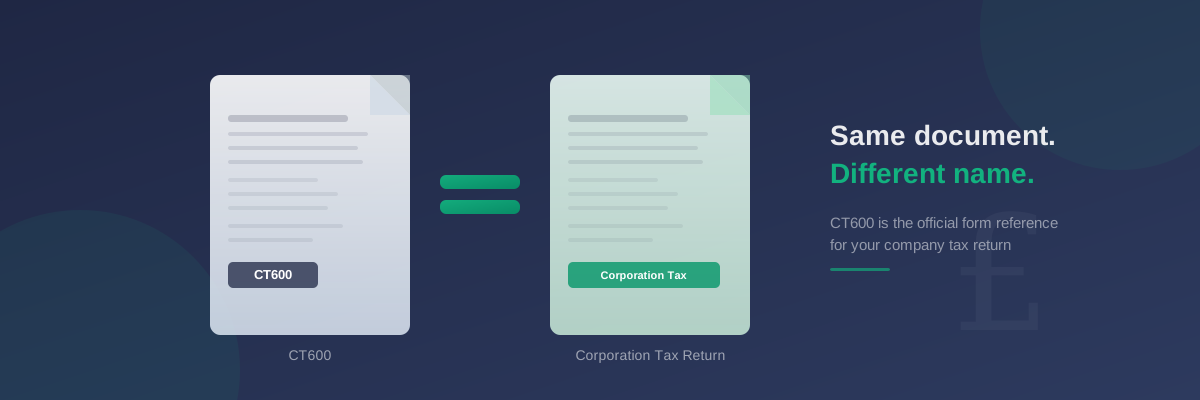
Yes — the CT600 is the corporation tax return. The two terms refer to the same document. When HMRC asks you to file a "company tax return" or a "corporation tax return," it's asking you to submit the CT600 form.
The confusion is understandable. The form has an official document reference (CT600), but HMRC correspondence, accountants, and online guidance use several terms interchangeably: "company tax return," "corporation tax return," "CT return," and "CT600." All of these mean the same thing.
The CT600 By Any Other Name
Here's a quick reference to all the names you might encounter:
| Term | Meaning |
|---|---|
| CT600 | The form reference number (like a document code) |
| Company tax return | HMRC's official plain-English name |
| Corporation tax return | An alternative plain-English name for the same document |
| CT return | Informal shorthand used by accountants |
| Tax return | Sometimes used informally — beware of confusion with self-assessment |
What Is the CT600?
The CT600 is the form every UK limited company must submit to HMRC after the end of each accounting period. It reports:
- The company's taxable profit or loss for the period
- The amount of corporation tax owed (or nil, if no tax is due)
- Any reliefs and allowances being claimed — such as capital allowances, R&D credits, or losses brought forward from prior years
- Supplementary information for more complex situations (ring fence income, chargeable gains, and so on)
Is the CT600 the Same as a Self-Assessment Return?
No — these are completely different documents.
The CT600 is submitted by limited companies to report company profits and calculate corporation tax.
The self-assessment tax return is submitted by individuals — including company directors — to report their personal income: salary, dividends, rental income, capital gains, and so on.
As a director, you'll typically need to deal with both: your company submits a CT600 to HMRC, and you personally file a self-assessment return. These are separate filings, on different timelines, through different parts of HMRC's systems. One is the company's obligation; the other is yours as an individual.
Is the CT600 the Same as Company Accounts?
No — though they're closely related.
Your company accounts are prepared for Companies House. They contain the profit and loss account, balance sheet, and directors' report. Accounts tell stakeholders — Companies House, shareholders, lenders — how the company performed financially during the period.
The CT600 uses those accounts as a starting point but adjusts the figures for tax purposes:
- Non-deductible expenses (such as client entertaining or personal costs) are added back to profit
- Accounting depreciation is removed and replaced with capital allowances
- Specific tax reliefs, credits, and loss deductions are then applied
For more on the distinction and what goes where, see Companies House vs HMRC filing: what's the difference?.
What's in the CT600 Form?
The CT600 is a numbered form — each box captures a specific figure. Key sections include:
| Section | What it covers |
|---|---|
| Company details | Legal name, registration number, UTR, accounting period dates |
| Income and profits | Trading profits, property income, investment income |
| Deductions and reliefs | Capital allowances, losses brought forward, group relief |
| Tax calculation | Taxable profit, rate applied, tax due |
| Tax credits | R&D credits, first-year tax credits, land remediation |
| Supplementary schedules | Ring fence income, chargeable gains, and complex situations |
What Are the Deadlines?
Two key deadlines apply for every accounting period:
| Deadline | Timing |
|---|---|
| Corporation tax payment | 9 months and 1 day after the end of the accounting period |
| CT600 filing | 12 months after the end of the accounting period |
Current corporation tax rates from GOV.UK, effective from 1 April 2023:
| Taxable profit | Rate |
|---|---|
| Up to £50,000 | 19% (small profits rate) |
| £50,001 – £250,000 | Marginal relief (effective rate between 19% and 25%) |
| Over £250,000 | 25% (main rate) |
How Is the CT600 Filed?
HMRC requires online filing using commercial CT600 software. Paper returns are not accepted in most cases — exceptions include filing in Welsh or demonstrating a reasonable excuse.
The general process:
- Prepare your company accounts (profit and loss account, balance sheet)
- Open your CT600 software and enter your company's UTR and accounting period dates
- Complete each relevant box — the software guides you through the return section by section
- Attach your accounts in iXBRL format (the software handles the conversion automatically)
- Review the completed return, then submit to HMRC online
- Pay corporation tax by the payment deadline via bank transfer
Do You Have to File If Your Company Made No Profit?
Yes. All UK limited companies are required to file a CT600 after each accounting period, including:
- Companies that made a trading loss
- Companies with zero income during the period
- Many dormant companies
For guidance on whether your specific circumstances require a filing, see Do I Need to File a CT600?.
Summary
CT600 and corporation tax return are different names for the same thing — the annual filing every UK limited company makes to HMRC. The CT600 is not the same as your company accounts (which go to Companies House) or a self-assessment return (which is personal). The form covers your company's taxable profit, the tax owed, and any reliefs being claimed. Filing is done online using approved software, and both a payment deadline and a filing deadline apply each year.